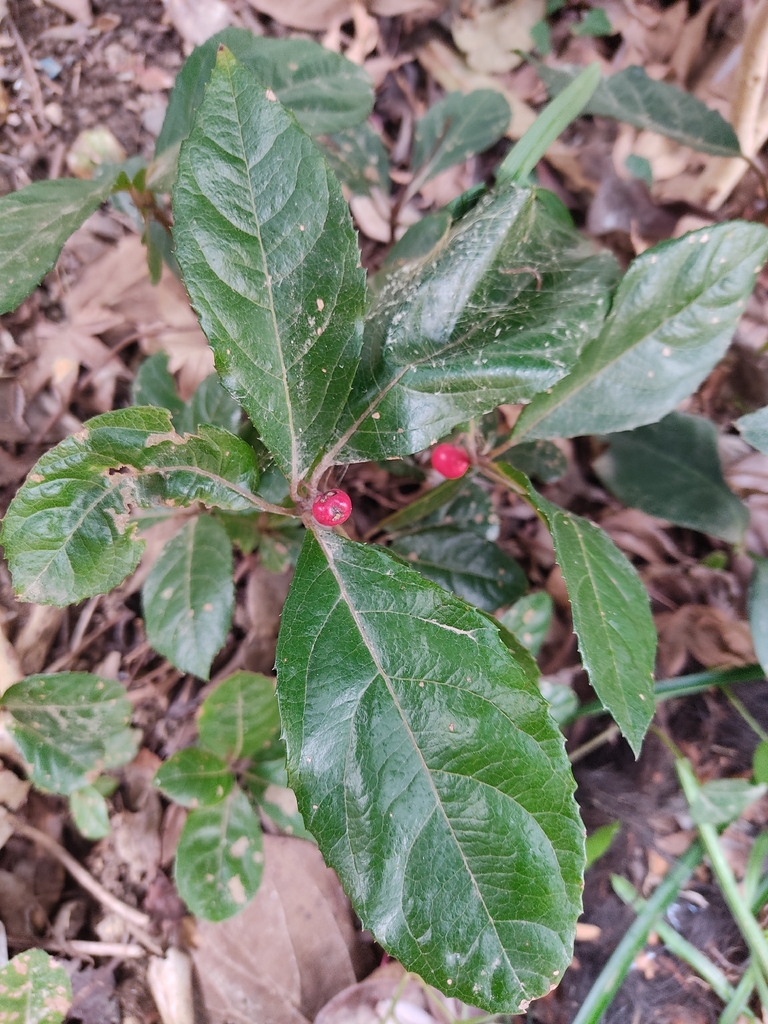
Ardisia japonica
- Origin
- Asia
- Part used
- See detailed notebook
- Tradition
- Traditional ethnobotany
In the damp undergrowth of Japan and southern China, Ardisia japonica grows quietly as an evergreen groundcover, its glossy leaves hiding a long-standing reputation as a medicinal plant. Traditional herbalists of East Asia, under the name "Zi Jin Niu" in Chinese pharmacopoeia, have long used it to support the respiratory and circulatory systems.
Traditional uses
Support for chronic coughs
Traditionally used in China and Japan to accompany persistent coughs and bronchial conditions, often combined with other plants.
Traditional circulatory tonic
Traditional Chinese medicine credits it with a role in moving stagnant blood, particularly after bruises or contusions.
Traditional liver support
Historically used as a companion plant for the liver, particularly in cases of chronic hepatitis in old Chinese medicine.
External use on bruises
The crushed plant or a compress made from it has traditionally been used to soothe bruises and superficial pain from blows.
Before you use it
Not recommended during pregnancy due to its traditional use linked to blood circulation and stagnation. Do not combine with anticoagulant or antiplatelet medication without professional advice, due to a possible effect on clotting. Traditional use is poorly documented outside Chinese and Japanese pharmacopoeia; caution calls for consulting a healthcare professional or trained herbalist before any prolonged use. Avoid in children and during breastfeeding, for lack of sufficient data.
The detailed notebook
- Prepared as a paste or decoction
- Traditional duration of use
- Known contraindications
- Related species and their uses
Where to find it
Partner herbalists — available with the detailed notebook.
Sources
PFAF