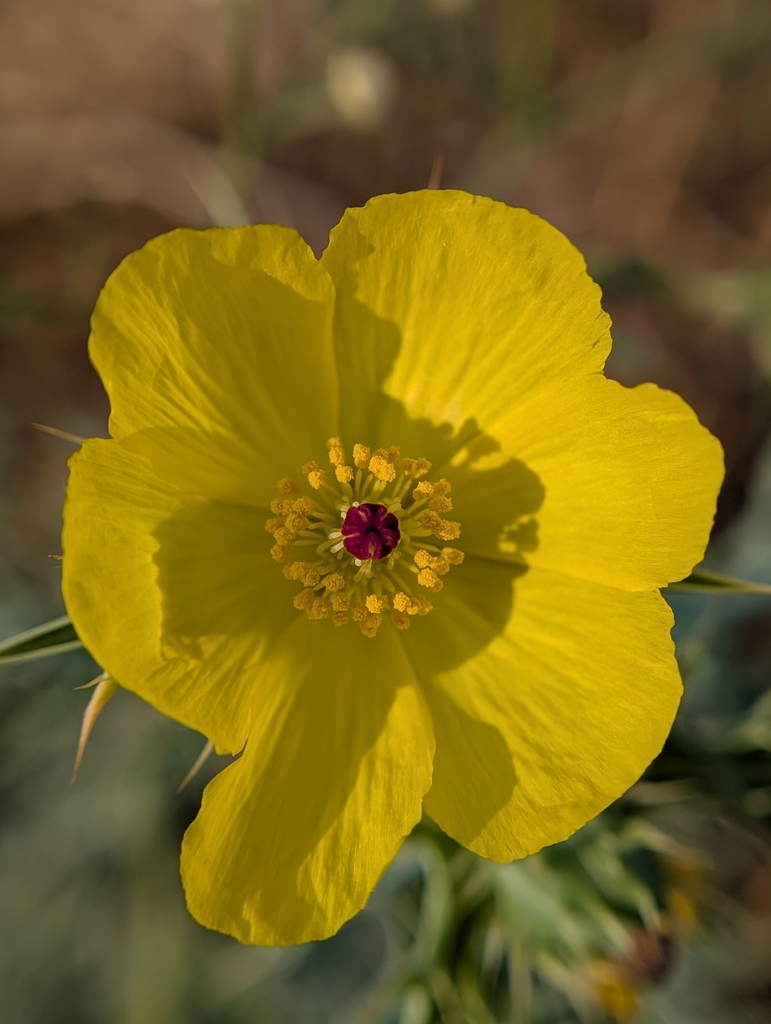
Mexican prickly poppy
- Origin
- North America
- Part used
- See detailed notebook
- Tradition
- Traditional ethnobotany
Native to the arid lands of Mexico and the southern United States, Mexican prickly poppy, with its bright yellow flower recalling the poppy, spread to many tropical regions where it was adopted by folk traditions. Its yellow-orange sap and harsh seeds earned it a reputation as an aid for troubled skin and stubborn pain, always handled with circumspection by the old herbalists.
Traditional uses
Sap applied to warts and wounds
The yellow latex drawn from the stem was traditionally dabbed, in small amounts, onto warts, corns, or stubborn skin lesions. It was also credited with a use for fungal skin conditions in certain folk pharmacopoeias.
A use for joint pain
A mild decoction of root or leaf was sometimes used as a rub or compress to ease muscle and joint pain, according to uses recorded in Central America and South Asia.
A poultice for abscesses and boils
The crushed leaves, as a poultice, were part of traditional care for abscesses and boils, in the hope of helping them come to a head.
Seeds used externally
The oil extracted from the seeds, known to be irritating, was used only in very limited external applications, never in food preparation, because of its long-recognized toxicity.
Before you use it
A toxic plant: the latex and seeds contain alkaloids (including sanguinarine) that can cause serious poisoning, notably toxic oil syndrome in cases of ingestion or food contamination. Internal use is strongly discouraged without supervision by a health professional qualified in herbal medicine. Contraindicated for pregnant or breastfeeding women, as well as young children. External use of the latex should remain occasional and localized; avoid any contact with the eyes and mucous membranes.
The detailed notebook
- Prepared as a paste or decoction
- Traditional duration of use
- Known contraindications
- Related species and their uses
Where to find it
Partner herbalists — available with the detailed notebook.
Sources
PFAF, PubMed, Wikipedia