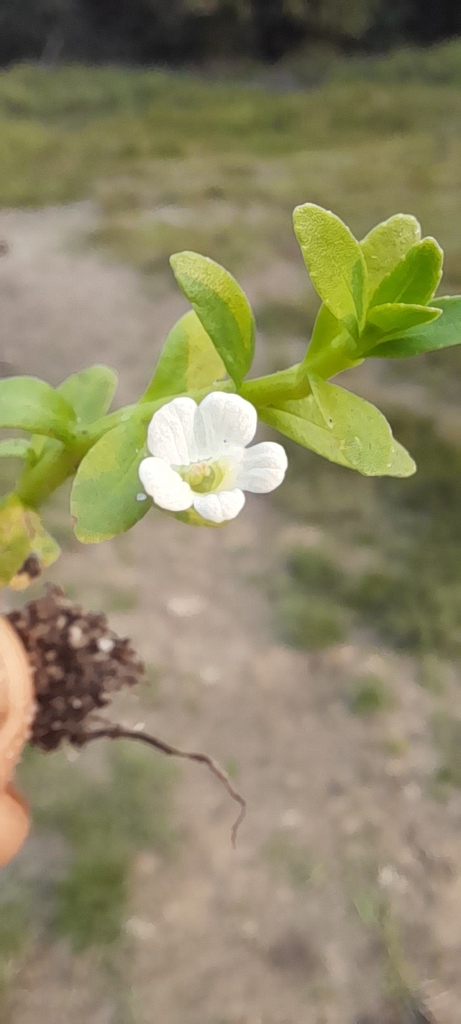
Bacopa crenata
- Origin
- Africa
- Part used
- See detailed notebook
- Tradition
- Traditional ethnobotany
Less well known than its Asian cousin Bacopa monnieri, Bacopa crenata grows in the wetlands of West Africa, where it has long found a place in village pharmacopeia. The ancients regarded it as a plant of watery places, discreet but useful, passed down from generation to generation within local knowledge still little documented outside these regions.
Traditional uses
Traditional digestive support
In certain regions of West Africa, the whole plant or its leaves were used as a decoction to help with mild digestive troubles, according to loosely formalized folk uses.
A traditional use against pain
Preparations made from Bacopa crenata have been reported in local traditional medicine to relieve certain bodily pain, though this use is not currently supported by solid data.
An old use during feverish states
The plant is among the traditional remedies mentioned to help with episodes of fever, within a logic of family medicine passed down orally.
Traditional skin applications
Certain uses report the use of the crushed fresh plant as a local application on the skin, as part of traditional care little detailed in the available literature.
What to know before use
Scientific data on the toxicity and safety of Bacopa crenata remain very limited; more caution is warranted than for better-studied plants. To be avoided in pregnant or breastfeeding women, for lack of reassuring safety data. Do not use in children without the advice of a health professional. Seek the advice of a professional before any prolonged use, particularly if undergoing medication treatment, due to poorly documented potential interactions.
The detailed notebook
- Prepared as a paste or decoction
- Traditional duration of use
- Known contraindications
- Related species and their uses
Where to find it
Partner herbalists — available with the detailed notebook.
Sources
PFAF