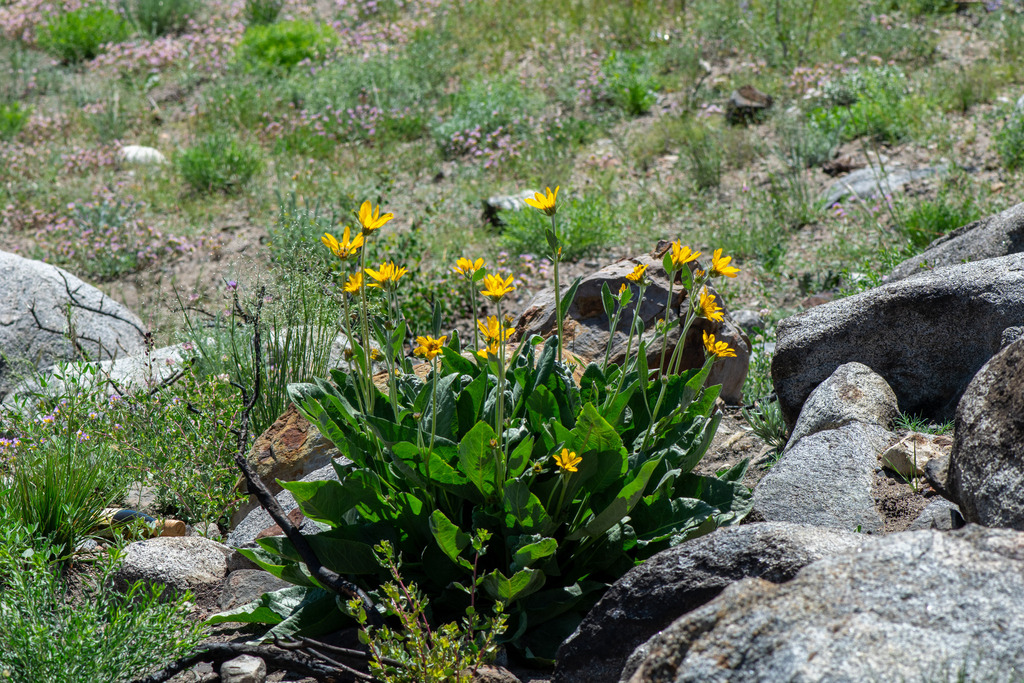
Balsamorhiza sagittata
- Origin
- North America
- Part used
- See detailed notebook
- Tradition
- Traditional ethnobotany
On the dry hills and rocky plateaus of the American West, Balsamorhiza sagittata raises its broad, arrowhead-shaped leaves and its bright yellow flowers. The Indigenous peoples of the Great Plains and the Plateau regarded it as a true pharmacy and pantry, using root, stem, seeds, and young shoots according to the season. Its English common name, "balsamroot," recalls the fragrant, balsamic resin held within its root.
Traditional uses
Support for the airways
The dried root was traditionally smoked or infused by certain Native American nations to ease coughing and lung ailments.
Care for wounds and burns
The resin and crushed root served as a poultice to help heal wounds, mild burns, and insect stings.
Traditional digestive comfort
A mild root decoction was sometimes drunk to relieve stomachaches and minor digestive trouble.
A tonic and fortifier
Considered fortifying, the root was traditionally used to support the body during fatigue or convalescence.
Before you use it
A traditional use poorly documented by modern research: seek the advice of a health professional before any internal use. A root rich in resins that can cause digestive or skin irritation in certain sensitive people. Discouraged for pregnant or breastfeeding women, as well as young children, for lack of sufficient data. Avoid self-harvesting without certain botanical identification, as the plant grows among other daisy-family species with different uses.
The detailed notebook
- Prepared as a paste or decoction
- Traditional duration of use
- Known contraindications
- Related species and their uses
Where to find it
Partner herbalists — available with the detailed notebook.
Sources
PFAF