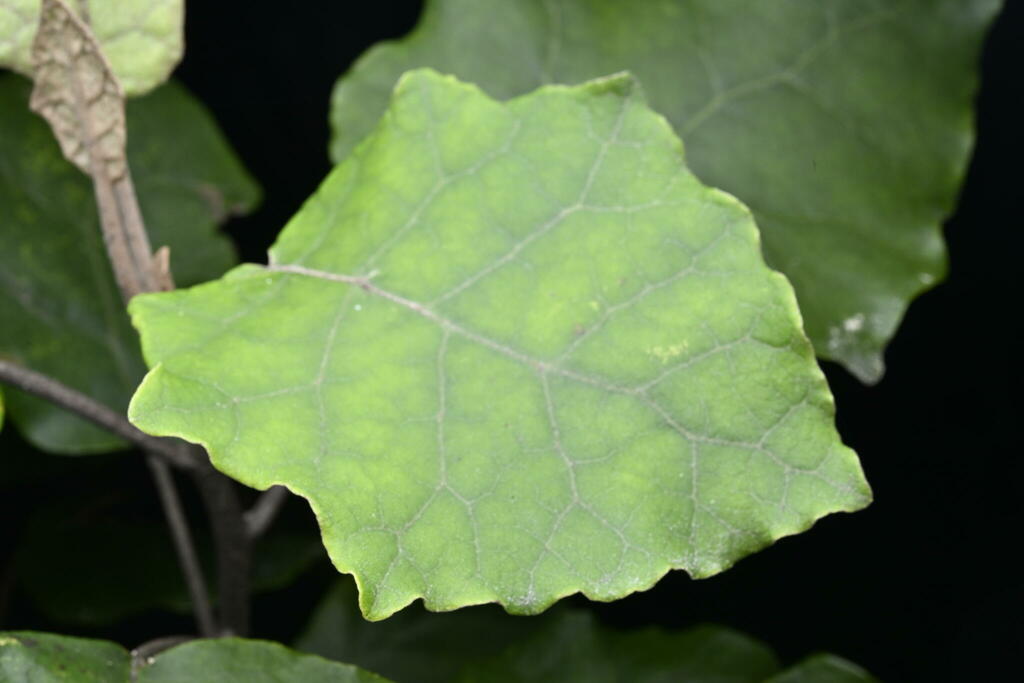
Brachyglottis repanda
- Origin
- Oceania
- Part used
- See detailed notebook
- Tradition
- Traditional ethnobotany
Known to the Maori of New Zealand as "rangiora," this shrub with silvery, downy foliage held a quiet but constant place in traditional Oceanian pharmacopoeia. Its large leaves, taut like natural paper, served as much to dress wounds as to carry words, scratched with a stylus by travelers through the bush.
Traditional uses
Application on wounds and ulcers
The downy, resinous underside of the leaf was traditionally applied directly to wounds, cuts, and skin ulcers to help clean and close them.
Warmed leaves for pain
Leaves lightly warmed near the fire were placed as a poultice on painful or swollen areas, notably joints and bruises.
Traditional use for respiratory ailments
Certain Maori communities report the use of leaf preparations to soothe pulmonary ailments, though this use is less documented than the skin application.
Leaves as a writing surface
Beyond care, the large, smooth, sturdy leaf served as a natural surface for writing messages while traveling through the forest, earning it the nickname "bush paper."
Before you use it
The resin and down of the leaf may cause irritation or skin reactions in sensitive skin; a small-area test is recommended before any application. Internal use (infusion, decoction) is poorly documented scientifically and should be discussed with a health professional or experienced herbalist before any use. This plant is not recommended during pregnancy or breastfeeding, or in young children, for lack of sufficient data. Avoid any contact with the eyes and mucous membranes, as the resinous side of the leaf may be irritating.
The detailed notebook
- Prepared as a paste or decoction
- Traditional duration of use
- Known contraindications
- Related species and their uses
Where to find it
Partner herbalists — available with the detailed notebook.
Sources
PFAF