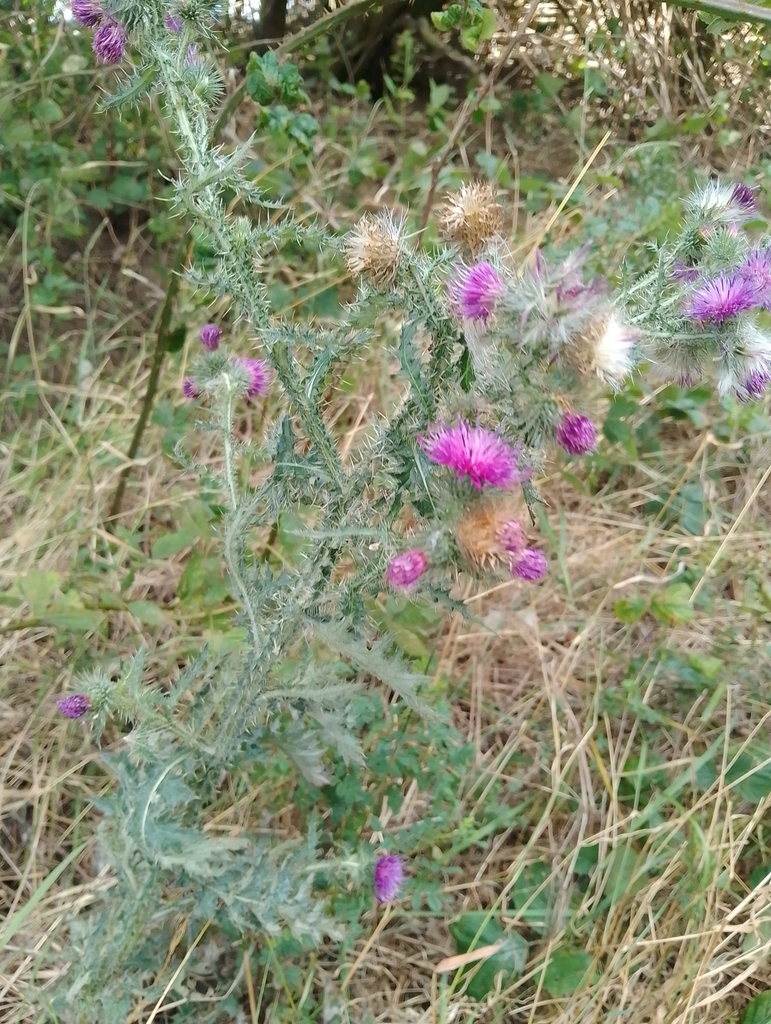
Carduus crispus
- Origin
- Europe
- Part used
- See detailed notebook
- Tradition
- Traditional ethnobotany
Curly plumeless thistle, standing tall along the paths and wastelands of Europe, belongs to that great family of thistles which old-time herbalists knew how to make use of, undeterred by its spines. Less celebrated than milk thistle, it nonetheless holds a place in the folk records of rural herbal medicine, where it was credited with tonic and depurative virtues. Its bristling silhouette and purple flowers make it a familiar plant of hedgerows and waste ground.
Traditional uses
Traditional digestive support
The roots and leaves of curly plumeless thistle were sometimes used as a decoction to help with slow digestion, in keeping with the tradition of bitter thistles used as digestive tonics.
A spring depurative plant
Like many thistles, it featured in popular seasonal depurative cures, said to ‘purify the blood’ in the old terminology of country herbalists.
Application to damaged skin
The crushed leaves, or as a poultice, were traditionally applied to minor wounds or skin irritations, a wound-healing use common among thorny plants of the daisy family.
Traditional use for mild fevers
Certain European folk traditions report its use as an infusion to help with passing feverish states, though this use remains poorly documented by reliable sources.
Before you use it
Traditional use poorly documented scientifically: seek the advice of a healthcare professional or qualified herbalist before any use. Handle the fresh plant with gloves, due to its spines and possible skin irritation. Avoid during pregnancy or breastfeeding, as well as in young children, as a precaution in the absence of sufficient data. Do not confuse with other thistles of the same family that have different profiles; confirm the botanical identification before any harvesting.
The detailed notebook
- Prepared as a paste or decoction
- Traditional duration of use
- Known contraindications
- Related species and their uses
Where to find it
Partner herbalists — available with the detailed notebook.
Sources
PFAF