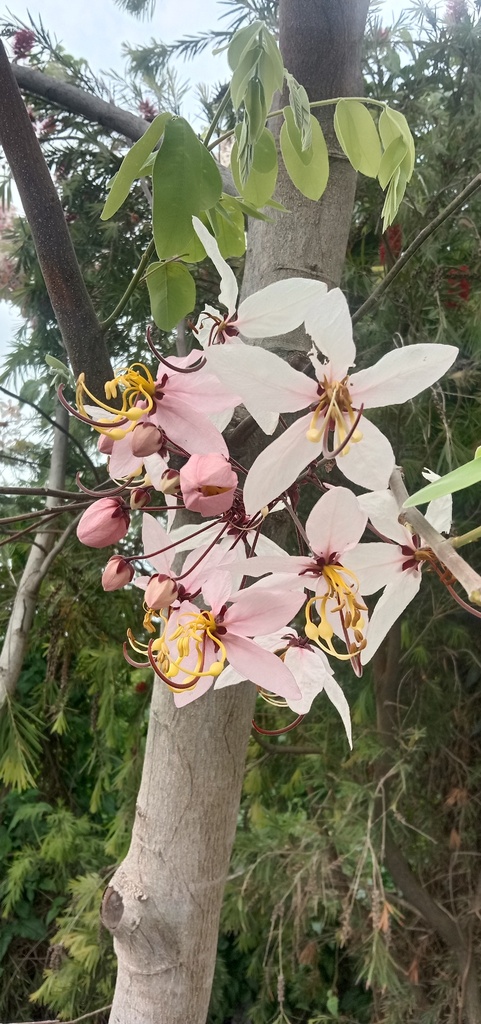
Cassia bakeriana
- Origin
- Asia
- Part used
- See detailed notebook
- Tradition
- Traditional ethnobotany
Native to the forests of Southeast Asia, Cassia bakeriana is distinguished by its clusters of pink flowers heralding the dry season. A cousin of the famous Cassia fistula, this plant belongs to a family whose several species are traditionally associated, in Thai and neighboring folk uses, with digestive troubles and transit function. The notebooks of mainland Asian herbalists retain its memory, more as a botanical and ornamental curiosity than as a widely codified remedy.
Traditional uses
Traditional support for transit
Like other members of the Cassia genus, the pod pulp is mentioned in certain Southeast Asian folk traditions to help with sluggish transit, occasionally.
A tree of ceremonies and renewal
In Thailand, the tree is planted near temples and associated with lunar New Year celebrations, its flowers being considered auspicious rather than medicinal.
Externally reported local use
Some folk uses mention applying bark- or leaf-based preparations to minor skin irritation, without solid scientific documentation to support it.
What to know before use
Cassia pod pulp, rich in anthraquinone compounds, is not recommended for prolonged use, in pregnant or breastfeeding women, or in children. Repeated laxative use can lead to transit dependence and electrolyte imbalances; it should remain only occasional. As this particular species is poorly documented scientifically compared to its cousins (Cassia fistula, senna), any internal use should be preceded by advice from a health professional or qualified herbalist. Avoid in cases of inflammatory bowel disorders or known drug interactions with stimulant laxatives.
The detailed notebook
- Prepared as a paste or decoction
- Traditional duration of use
- Known contraindications
- Related species and their uses
Where to find it
Partner herbalists — available with the detailed notebook.
Sources
PFAF