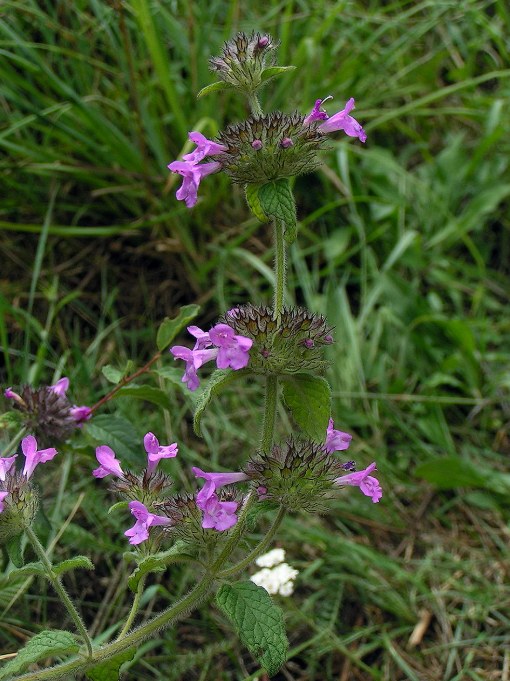
Wild basil
- Origin
- Europe
- Part used
- Flowering tops
- Tradition
- Traditional ethnobotany
A discreet cousin of savory and basil within the mint family, this small plant of calcareous soils grows wild across Europe, from southern England to the Balkans. Its scientific name, Clinopodium — from the ancient Greek ‘klínō,’ to lean, and the Latin ‘podium,’ foot — evokes its low, trailing silhouette. The English herbalist John Gerard already described it in 1597 in his Herball, not without a touch of irony, nicknaming it ‘Unprofitable Basil’ for its lack of true basil's fragrance; he nonetheless recommended its juice, crushed with wine, to soothe eye irritation. In Bulgaria, where it is popularly nicknamed ‘cat's paw’ (котешка стъпка), it remains used externally in tradition against warts and for wound healing.
Traditional uses
Digestive
Traditionally used as a mild digestive tonic in the folk pharmacopeia of Central Europe and the Balkans, where the plant is brewed as a tea to ease stomach and intestinal pain. This specific use is reported on the packaging of a Bulgarian commercial product; the claim should be verified and reworded by a healthcare professional before publication.
Circulation & heart
Traditional use reported on the packaging of a Bulgarian commercial product to regulate heart activity and high blood pressure — a claim not corroborated in the botanical literature consulted (Gerard, 1597; recent phytochemical reviews) and to be strictly verified by a healthcare professional before any publication.
Sleep
Traditional use reported on the packaging of a Bulgarian commercial product for insomnia, within the same family (mint family) as other well-documented calming plants (lemon balm, lavender) — a claim specific to Clinopodium vulgare not scientifically corroborated to date, to be verified before publication.
Stress & anxiety
Traditional use reported on the packaging of a Bulgarian commercial product as a nerve-calming remedy — a claim to be verified and reworded by a healthcare professional before publication, the available scientific literature focusing mainly on the plant's antioxidant and antimicrobial activity rather than any demonstrated anxiolytic effect.
Pain & inflammation
Traditional use reported on the packaging of a Bulgarian commercial product for headaches; to be distinguished from the better-documented historical use of the plant in sixteenth-century England (the herbalist Gerard, 1597) to soothe pain and eye irritation as an external application. This internal claim is to be verified before publication.
The detailed notebook
- Prepared as a paste or decoction
- Traditional duration of use
- Known contraindications
- Related species and their uses
Where to find it
Partner herbalists — available with the detailed notebook.
Sources
John Gerard, The Herball (1597); phytochemical review PMC10834805; Wikipedia (FR); product packaging (Деми-Елена Андреева 61 ООД, Bulgaria)