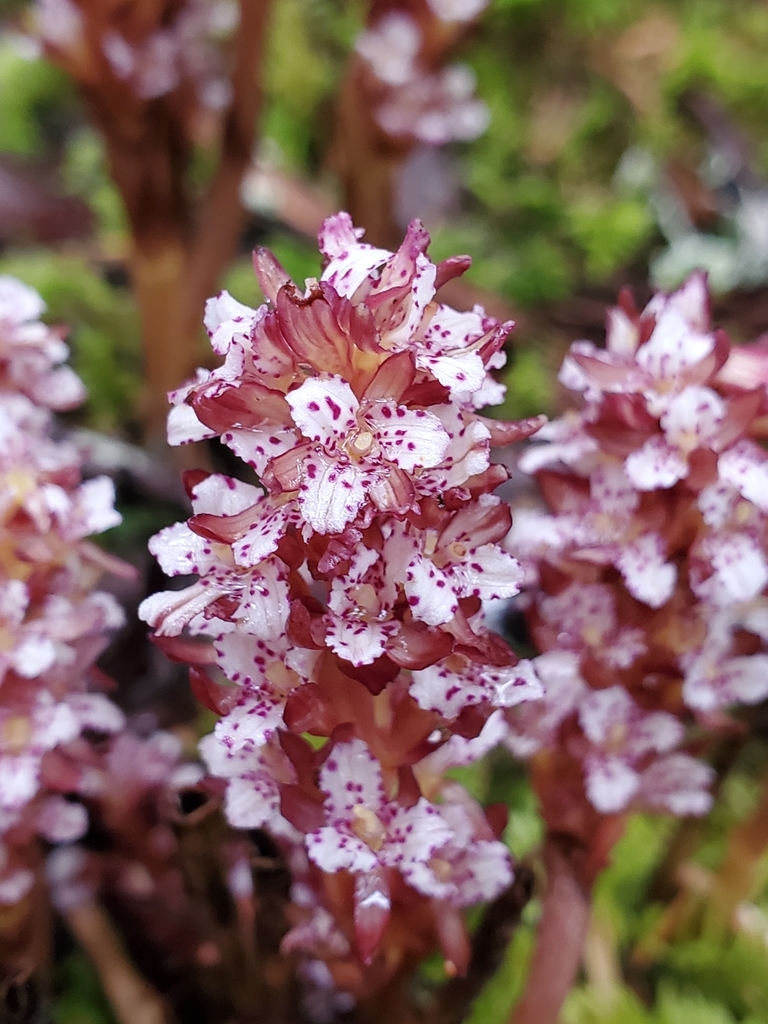
Corallorhiza maculata
- Origin
- North America
- Part used
- See detailed notebook
- Tradition
- Traditional ethnobotany
Quiet, leafless, and without chlorophyll, Corallorhiza maculata — or spotted coralroot — grows in the shade of North American forests, drawing its sustenance from soil fungi rather than the sun. The Indigenous peoples of North America had long known it and gave it a modest but particular place in their traditional uses. Its singular appearance and relative rarity have made it a plant surrounded by discretion, mentioned in herbalist notebooks more often than widely used.
Traditional uses
Application to wounds and rashes
The root decoction was traditionally applied as an external wash to certain skin conditions and minor wounds, according to uses reported among several Native American nations.
A traditional use for feverish chills
Some ethnobotanical sources mention an internal use of the plant, at a low dose, to help with feverish states accompanied by chills.
Occasional digestive support
A more anecdotal use mentions a light preparation meant to ease passing digestive discomfort, though this indication is not widely documented.
A rare, symbolic plant to gather
Because of its rarity and its mycoheterotrophic way of life, the plant also held a particular place in certain ritual or symbolic uses more than strictly medicinal ones.
Before you use it
Documentation on this plant remains limited and fragmentary; any internal use must be supervised by a health professional or an experienced herbalist. A mycoheterotrophic species rare in certain regions: its harvesting may be regulated or discouraged for conservation reasons. Avoid any use in pregnant or breastfeeding women, as well as young children, for lack of sufficient data. Do not confuse it with other similar wild orchids; certain botanical identification is essential before any harvesting.
The detailed notebook
- Prepared as a paste or decoction
- Traditional duration of use
- Known contraindications
- Related species and their uses
Where to find it
Partner herbalists — available with the detailed notebook.
Sources
PFAF