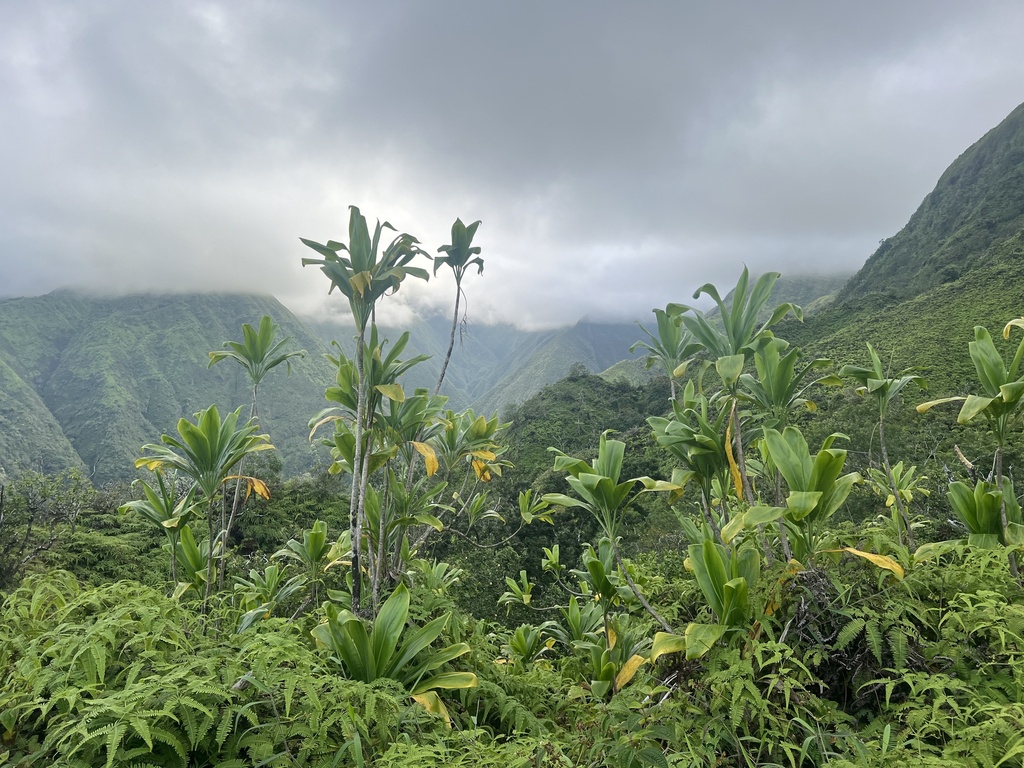
Cordyline fruticosa
- Origin
- Oceania
- Part used
- See detailed notebook
- Tradition
- Traditional ethnobotany
In the islands of the Pacific, Cordyline fruticosa — also called ti, or the "tree of good fortune" — has stood for centuries around dwellings and along sacred paths. An emblematic plant of Polynesian, Melanesian, and Hawaiian cultures, it was honored as much for its protective virtues as for its traditional household and medicinal uses.
Traditional uses
Soothing skin irritations
The warmed or crushed leaves were traditionally applied as a poultice on wounds, bruises, or skin irritations, according to uses reported across several Pacific archipelagos.
Relief for joint pain
A decoction of roots or leaves was used in certain Oceanian traditions to relieve muscular and joint pain, both as an external application and as a bath.
Traditional accompaniment for feverish states
Certain Pacific communities report the use of leaves as a decoction to accompany feverish states, as home care rather than a proven therapeutic use.
A protective, ritual plant
Beyond care, ti was planted around dwellings and worn as an ornament during ceremonies, considered a plant of protection against malevolent spirits in several Polynesian cultures.
Before you use it
This traditional use is mainly documented externally; internal use (leaves, roots) is poorly studied and should be avoided without supervision by a qualified professional. Certain parts of the plant may cause irritation in domestic animals and potentially in humans; avoid any prolonged contact with broken skin without prior advice. Not advised during pregnancy or breastfeeding, and in young children, for lack of sufficient safety data. Do not confuse with other ornamental species of the genus Cordyline or Dracaena, whose composition may differ.
The detailed notebook
- Prepared as a paste or decoction
- Traditional duration of use
- Known contraindications
- Related species and their uses
Where to find it
Partner herbalists — available with the detailed notebook.
Sources
Wikipedia