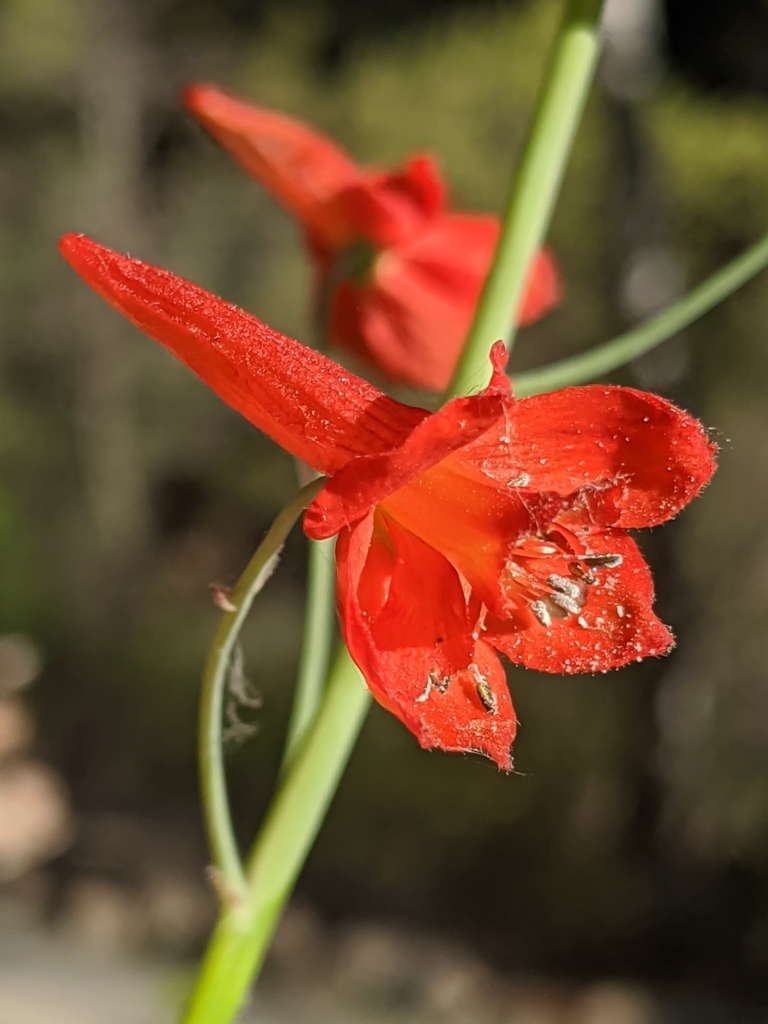
Delphinium nudicaule
- Origin
- North America
- Part used
- See detailed notebook
- Tradition
- Traditional ethnobotany
On the rocky slopes and open woodlands of the North American Pacific coast, Delphinium nudicaule raises its orange-red spikes, which once drew hummingbirds and the curious gaze of passing herbalists. This larkspur, cousin to the European species well known for their toxicity, has never held a notable place in traditional wellness uses, and its history belongs more to botanical observation than to folk pharmacopoeia.
Traditional uses
A plant rarely used in care
Unlike other larkspurs, this species has only very rarely been reported in folk healing uses; it belongs mainly to the history of ornamental botany and to the observation of North American wild flora.
Occasional ethnobotanical mentions
Some ethnobotanical sources mention a very occasional and cautious use by Indigenous peoples of the West Coast, though the precise nature and reliability of these uses are not well established today.
A reputation tied to toxicity
Like other larkspurs, the plant was mainly known and avoided by ranchers for its toxicity to livestock, which contributed to its reputation as a plant to be handled with great caution rather than as a medicinal one.
A plant for observation and gardens
Today, Delphinium nudicaule is mainly grown and admired for the beauty of its red flowers, valued by gardeners and native-flora enthusiasts more than for any traditional internal or external use.
Before you use it
The whole plant is considered toxic, like other delphinium species, due to diterpenoid alkaloids related to those found in aconite. Ingestion can cause serious cardiac and neuromuscular disturbances; it is strongly discouraged in any form, even in small quantity. Absolutely to be avoided in pregnant or breastfeeding women, children, and people on cardiovascular treatment. No internal or external use should be undertaken without the advice of a qualified health professional; this entry is presented for historical and informational purposes only.
The detailed notebook
- Prepared as a paste or decoction
- Traditional duration of use
- Known contraindications
- Related species and their uses
Where to find it
Partner herbalists — available with the detailed notebook.
Sources
PFAF