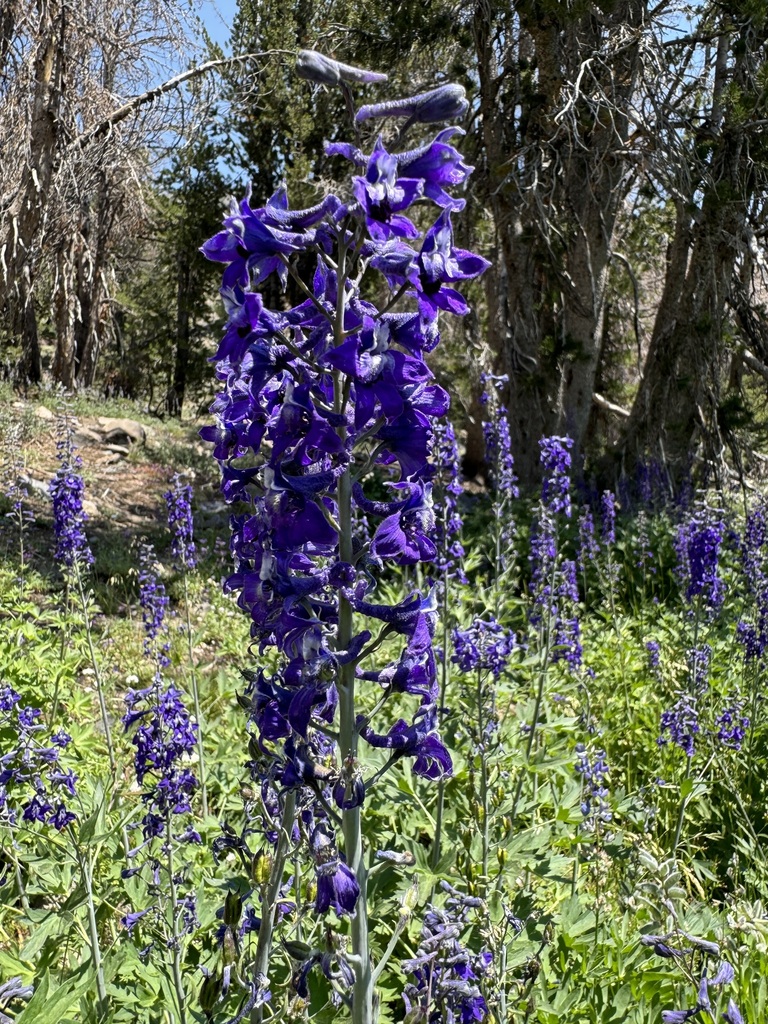
Delphinium scopulorum
- Origin
- North America
- Part used
- See detailed notebook
- Tradition
- Traditional ethnobotany
In the high rocky valleys of North America, Delphinium scopulorum unfolds its blue-violet spikes among the high-altitude scree. Indigenous nations and the first botanists of the American West knew this plant above all for its danger, classing it among the herbs to be handled with extreme caution rather than among the common simples.
Traditional uses
Application for stings and parasites
Some traditions report a very limited external use, as a diluted poultice, against lice or certain skin parasites, due to the recognized toxicity of the sap and seeds to insects.
Repellent against livestock pests
In certain mountainous regions, the dried and ground plant is said to have been used, with great caution, as a repellent against certain external parasites of farm animals.
A plant marked by mistrust
Among several Rocky Mountain peoples, wild larkspur figured more in cautionary tales told to children than in therapeutic uses, so feared was its toxicity.
An object of botanical and toxicological observation
The early naturalists and ranchers of the American West mainly documented this species for its role in livestock poisoning, making it historically a subject of toxicological rather than medicinal study.
Before you use it
All parts of the plant, especially the young shoots and seeds, contain highly toxic diterpenoid alkaloids (including compounds related to aconitine) for both humans and livestock. No traditional internal use is considered safe: ingestion can cause serious, sometimes fatal, cardiac and respiratory disturbances. Absolutely to be avoided in pregnant or breastfeeding women, in children, and in those undergoing treatment for the heart or blood pressure. Never confuse with edible plants or other ornamental delphiniums; in case of accidental ingestion, contact a poison control center immediately.
The detailed notebook
- Prepared as a paste or decoction
- Traditional duration of use
- Known contraindications
- Related species and their uses
Where to find it
Partner herbalists — available with the detailed notebook.
Sources
PFAF