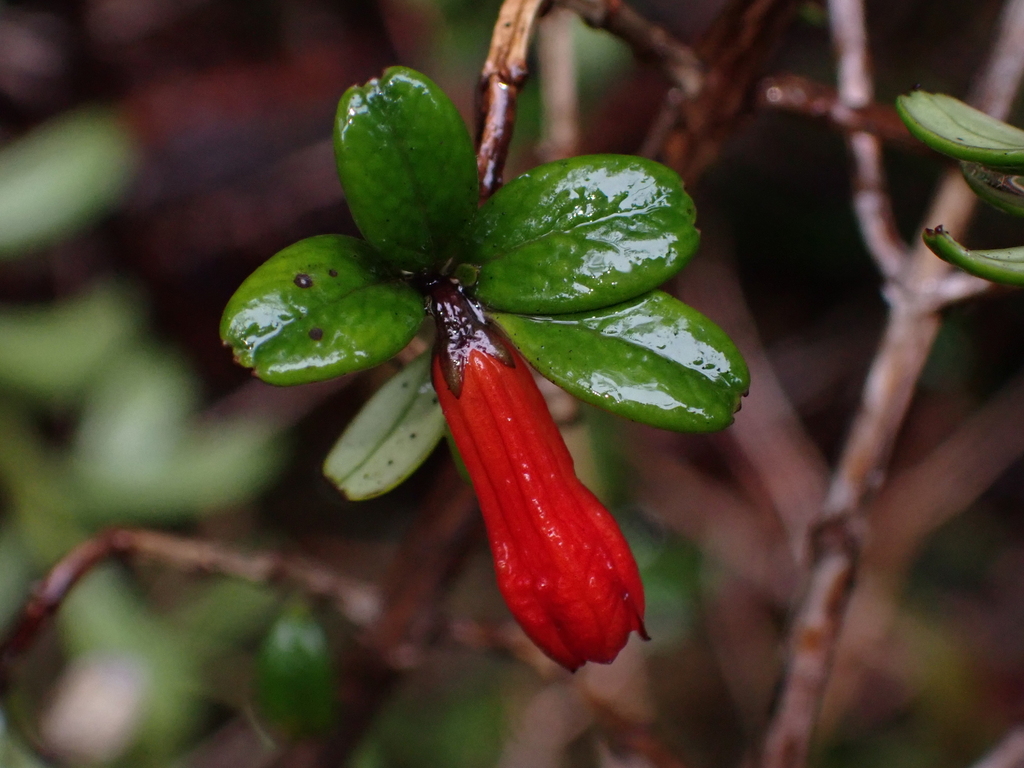
Desfontainia
- Origin
- South America
- Part used
- See detailed notebook
- Tradition
- Traditional ethnobotany
In the humid forests and Andean foothills, Desfontainia, a shrub with leaves reminiscent of holly and red-and-gold tubular flowers, occupies a discreet but distinctive place in the herbal memory of South America. Some communities in Chile and Peru, notably within Mapuche and Andean traditions, credited it with visionary and curative powers, while regarding it as a plant to be handled with great respect.
Traditional uses
A plant of Andean visions
Desfontainia (sometimes called “taique” or “chapico”) was traditionally associated with shamanic practices in certain Andean regions, used very occasionally for its reported psychoactive effects.
A traditional external use
The leaves were sometimes applied topically in folk medicine to relieve pain or superficial inflammation, although this use is poorly documented in written sources.
An occasional decoction
A light leaf decoction is reported to have been used occasionally and cautiously against certain digestive troubles, a traditional use that remained marginal and uncommon.
A folk fever remedy
In some rural folk traditions, Desfontainia is among the plants mentioned for reducing fever, a use passed down more orally than in writing.
What to know before use
A plant containing tropane alkaloids and compounds with psychoactive and potentially toxic effects; all ingestion should be avoided outside a very strict traditional framework and thorough knowledge. Never use without the advice of a health professional or an experienced expert, owing to reported neurological effects (visual disturbances, confusion, hallucinations). Formally not recommended for pregnant or breastfeeding women, children, or anyone under medication. Internal use, even in small amounts, carries poorly documented scientific risks; caution requires sticking to historical knowledge rather than personal experimentation.
The detailed notebook
- Prepared as a paste or decoction
- Traditional duration of use
- Known contraindications
- Related species and their uses
Where to find it
Partner herbalists — available with the detailed notebook.
Sources
PFAF