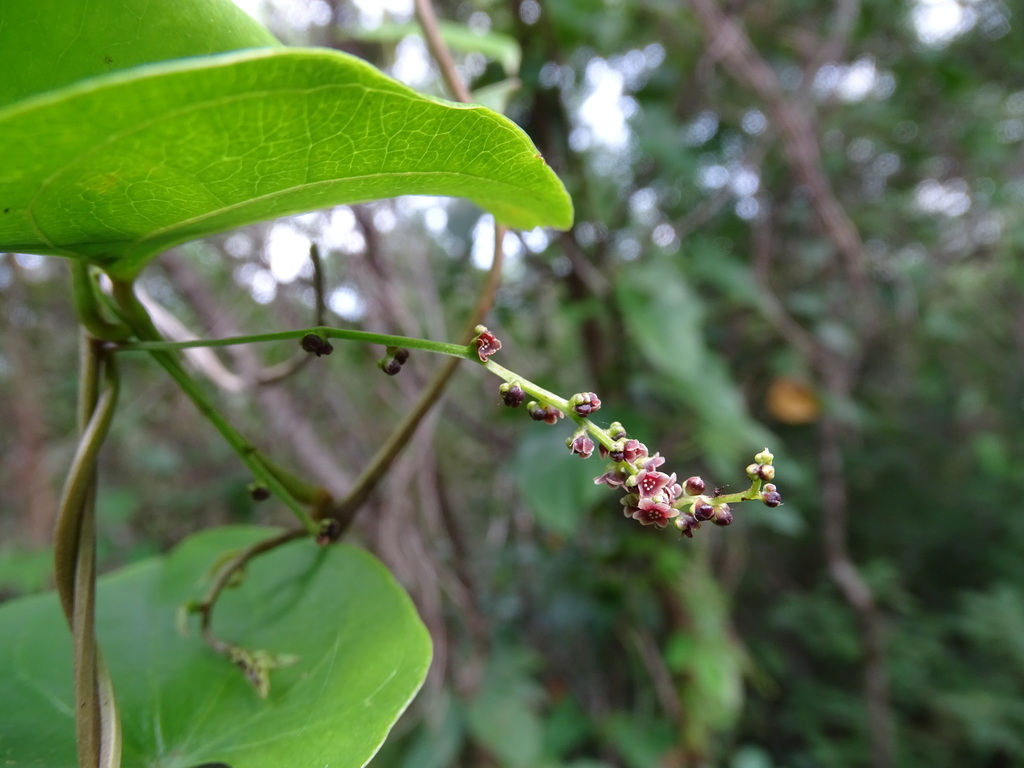
Dioscorea floribunda
- Origin
- North America
- Part used
- See detailed notebook
- Tradition
- Traditional ethnobotany
Dioscorea floribunda belongs to the great family of wild yams, climbing plants whose tuberous rhizomes have long interested herbalists and chemists for their richness in steroidal saponins. Less well known to the general public than its cousin Dioscorea villosa, this yam nonetheless held a notable place in the history of twentieth-century pharmacognosy, notably as an industrial source of diosgenin. Herbalist notebooks report few direct folk uses for it, most of its history belonging instead to botanical and chemical research.
Traditional uses
Traditional precursor of hormonal compounds
The rhizome of this yam was historically exploited as a source of diosgenin, a plant precursor used in the synthesis of steroidal compounds; some herbalist traditions attributed to it a use linked to women's balance, as with other wild yams.
Traditional digestive support
Like other Dioscorea species, the rhizome was sometimes used in a local preparation to soothe digestive discomfort and mild intestinal spasms, according to uses reported in regions where the wild yam was known.
Traditional anti-inflammatory use
Some folk traditions associated with wild yams mention using the rhizome to relieve joint and rheumatic pain, although this use is not specifically and abundantly documented for this particular species.
A soothing external application
The crushed rhizome is said to have sometimes been used as a poultice in certain local traditions to soothe skin irritation, a use reported generally for several species of wild yam.
Before you use it
This plant contains steroidal saponins that may interact with hormonal treatments or certain medications; medical advice is essential before any use. Discouraged during pregnancy or breastfeeding due to its potentially hormonally active compounds. Do not consume the rhizome raw or poorly prepared: some wild yam species contain irritating or toxic compounds in their raw state. Use in children is not documented and should be avoided as a precaution.
The detailed notebook
- Prepared as a paste or decoction
- Traditional duration of use
- Known contraindications
- Related species and their uses
Where to find it
Partner herbalists — available with the detailed notebook.
Sources
PFAF