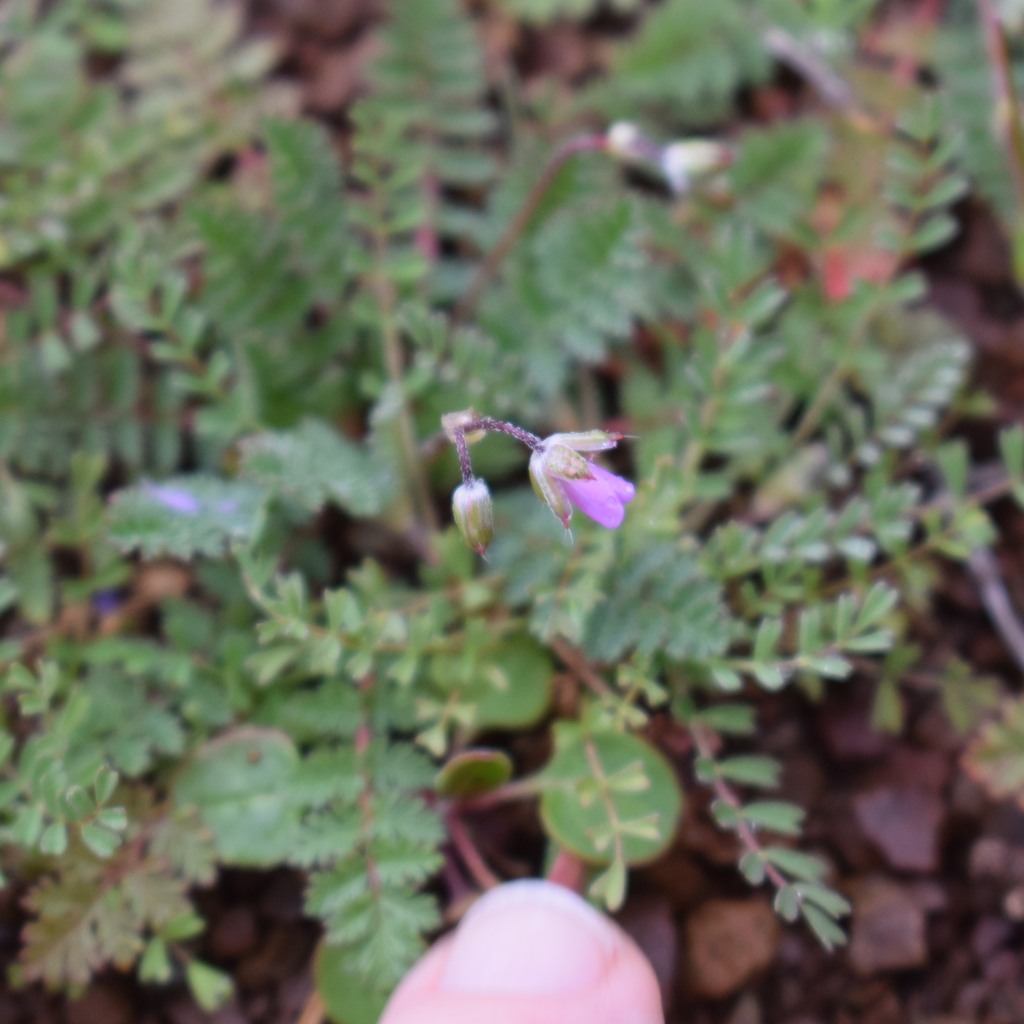
Erodium cicutarium
- Origin
- North America
- Part used
- Seeds/fruits, Root
- Tradition
- Traditional ethnobotany
Erodium cicutarium, also called redstem filaree or stork's bill, is a small plant of dry ground whose leaves recall those of hemlock, without sharing its toxicity. The Indigenous peoples of North America, where the plant became widely naturalized after arriving from Europe, made discreet but steady use of it in their plant pharmacopoeias. It can still be found today in certain field herbalists' notebooks, more through oral tradition than scholarly writing.
Traditional uses
Easing mild digestive troubles
The root and seeds were traditionally infused to accompany common digestive discomforts, in the manner of many astringent plants of the same kind.
Traditional care for minor wounds
Preparations from dried root were used locally, externally, to help clean small cuts or skin irritations.
A traditional use around menstruation
Some Indigenous communities report a use of the root in connection with the female cycle, particularly to accompany menstruation considered too heavy.
A modest field tonic plant
Regarded as a modest tonic plant, it was among the botanical resources gathered during spring harvests for general supportive use.
Before you use it
A traditional use poorly documented by modern research: caution remains warranted, particularly for any prolonged use. To be avoided in pregnant or breastfeeding women, given the traditional uses reported around the female cycle. Do not use in young children without the advice of a health professional. If undergoing medication treatment, seek professional advice before any use, as a precaution.
The detailed notebook
- Prepared as a paste or decoction
- Traditional duration of use
- Known contraindications
- Related species and their uses
Where to find it
Partner herbalists — available with the detailed notebook.
Sources
PFAF, Wikipedia