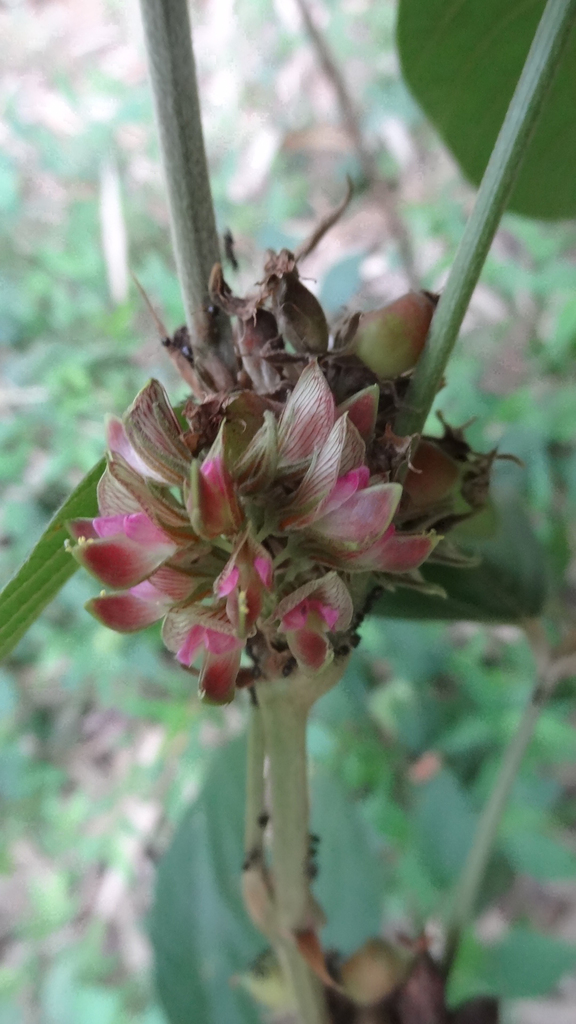
Flemingia macrophylla
- Origin
- Asia
- Part used
- Seeds / fruit
- Tradition
- Traditional ethnobotany
Little known outside its native range, Flemingia macrophylla is a leguminous shrub of South and Southeast Asia, long used in village pharmacopeia to soothe pain and skin conditions. Traditional local herbalists made use of its seeds and fruits, reputed to be rich in active compounds, in simple preparations passed down from generation to generation. Its use today remains confined to traditional knowledge and warrants the caution due to scientifically poorly documented plants.
Traditional uses
Relief of joint pain
In certain regions of Asia, Flemingia macrophylla seeds were traditionally used as a local application to relieve joint and muscle pain.
Traditional care for skin conditions
The fruits and seeds, ground into powder or paste, were sometimes used externally to help with certain skin discomforts, according to local folk practices.
Empirical use against swelling
The plant appears in a few ethnobotanical records as an empirical remedy against swelling and superficial inflammation, applied as a poultice.
Occasional traditional use as a decoction
More rarely, a light decoction of the seeds was reportedly used in certain communities to help with minor digestive troubles, without abundant documentation.
What to know before use
Traditional use scientifically poorly documented: seek the advice of a health professional before any use, even external. Avoid any internal use without supervision, as the composition and potential toxicity of the seeds are not clearly established. To be avoided in pregnant or breastfeeding women and in children, as a precautionary principle. Do not use on an open wound or broken skin without prior medical advice.
The detailed notebook
- Prepared as a paste or decoction
- Traditional duration of use
- Known contraindications
- Related species and their uses
Where to find it
Partner herbalists — available with the detailed notebook.
Sources
Wikipedia