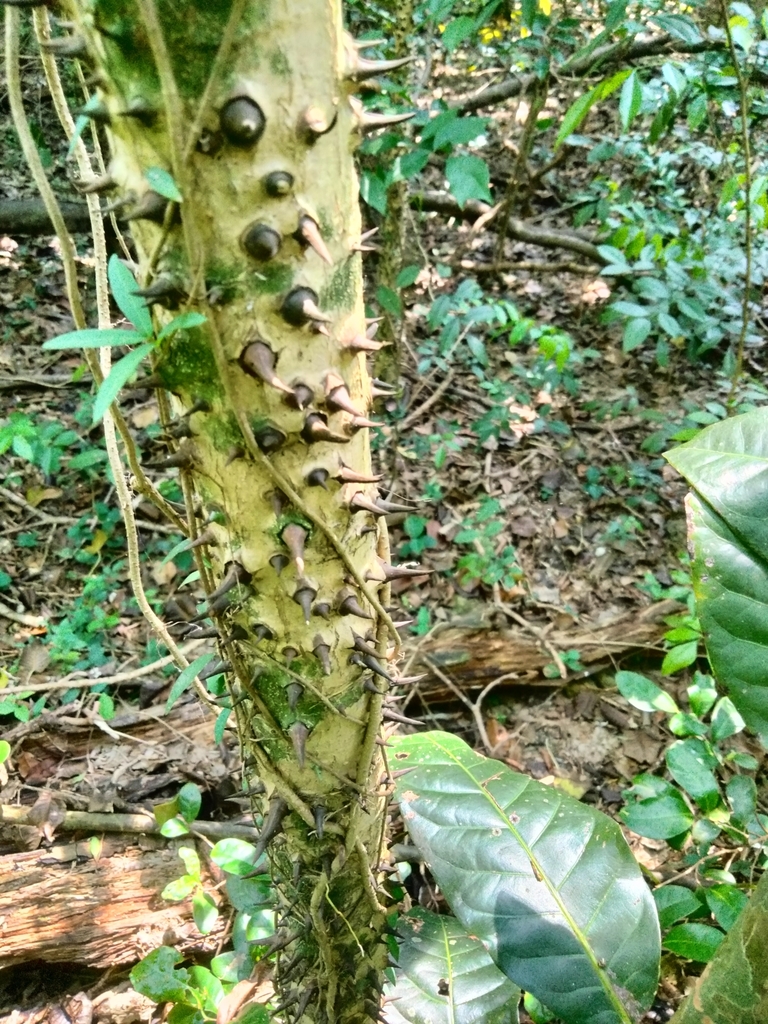
Hura crepitans
- Origin
- North America
- Part used
- Leaves
- Tradition
- Traditional ethnobotany
Named the "sandbox tree" or "dynamite tree" for its fruits that burst with a crack, scattering their seeds, Hura crepitans is a giant of the American tropical forests, bristling with spines and bearing a milky sap long feared by the peoples who lived in its shade. Traditional healers of Central and South America credited it with virtues, but handled it with extreme caution, well aware of its very real toxicity.
Traditional uses
Application to skin ailments
The latex and leaf-based preparations, heavily diluted, were sometimes used on certain skin conditions such as leprosy or warts, according to uses reported in several regions of tropical America.
Friction rubs against rheumatism
Decoctions or macerations of leaves were traditionally used as an external rub to relieve joint and muscle pain.
Fish poison and vermifuge
The highly toxic sap and seeds were traditionally used to poison arrows or stun fish; a very cautious, minute-dose vermifuge use of the leaves is also reported in certain local pharmacopoeias.
An extreme traditional purgative use
Historically, very small quantities of preparations from the plant may have been used as a violent purgative, a use now abandoned owing to the serious risks it carries.
Before you use it
A highly toxic plant in all its parts (sap, seeds, leaves, bark): never consume without the supervision of a qualified professional, or better, abstain entirely from any internal use. The latex is a powerful irritant to the skin and mucous membranes; it can cause burns, blisters, and severe inflammation on contact with the eyes. Contraindicated in pregnant or breastfeeding women, in children, and in cases of doubt about the plant's identification. In case of accidental ingestion or significant contact with the sap, consult a doctor or poison control center immediately.
The detailed notebook
- Prepared as a paste or decoction
- Traditional duration of use
- Known contraindications
- Related species and their uses
Where to find it
Partner herbalists — available with the detailed notebook.
Sources
PFAF, Wikipedia