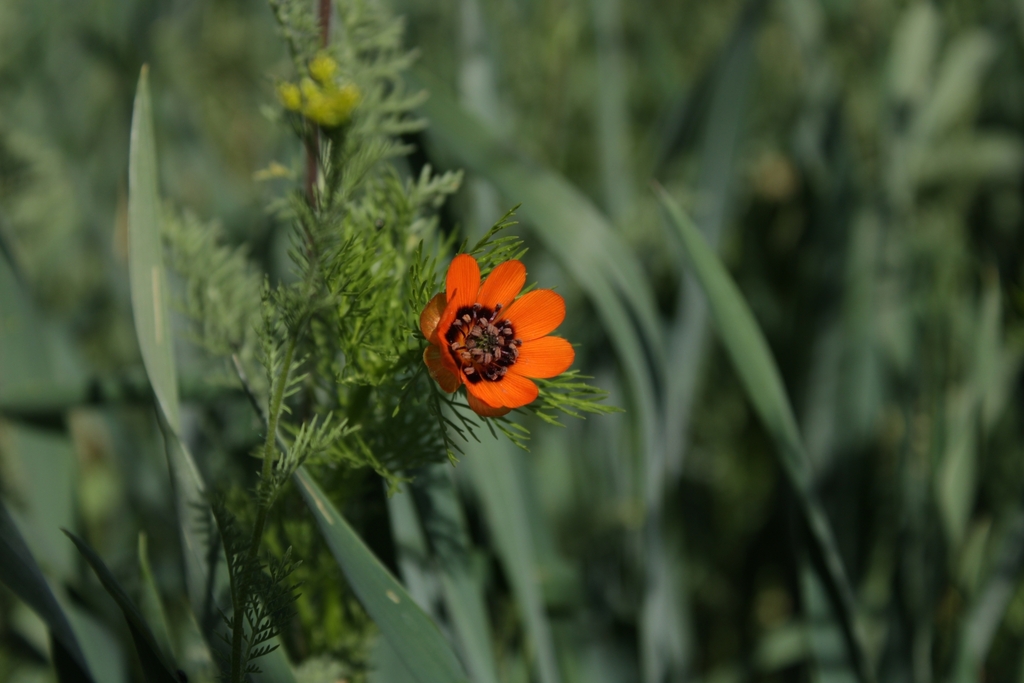
Summer Adonis
- Origin
- Europe
- Part used
- See detailed notebook
- Tradition
- Traditional ethnobotany
Summer adonis, a discreet scarlet star of Europe's grain fields, owes its name to the legend of beautiful Adonis, whose blood was said to have given rise to its red petals. A cousin of spring adonis, it was long observed by herbalists for its recognized action on the heart and circulation, before being supplanted by better-dosed, standardized preparations. Its toxicity, known for centuries, makes it today a plant of history more than of everyday practice.
Traditional uses
Traditional support for heart rhythm
Summer adonis was traditionally used, like foxglove, to support a tired or irregular heart, particularly in the countryside of Central and Eastern Europe.
Use for mild circulatory insufficiency
Old herbalists attributed to it a tonic action on circulation, used with great caution in cases of diagnosed heart weakness.
Easing of breathlessness
Combined with other cardiotonic plants, it was sometimes used to relieve breathlessness linked to a weak heart, more a side effect of its cardiac action than a direct respiratory use.
Support for fluid elimination
Folk tradition recognized in it mild diuretic properties, often sought as a complement to its cardiac action in cases of cardiac edema.
Before you use it
A toxic plant containing cardiotonic glycosides similar to those of foxglove: any internal use must be supervised by a qualified healthcare professional, and never self-administered. Formally contraindicated in pregnancy, breastfeeding, children, and in cases of already-treated heart conditions. High risk of interaction with cardiac treatments (digitalis drugs, beta-blockers, diuretics) and certain medications: never combine without medical advice. Confusion with digitalis glycosides can lead to serious overdose; the margin between an effective dose and a toxic one is very narrow.
The detailed notebook
- Prepared as a paste or decoction
- Traditional duration of use
- Known contraindications
- Related species and their uses
Where to find it
Partner herbalists — available with the detailed notebook.
Sources
PFAF, Wikipedia