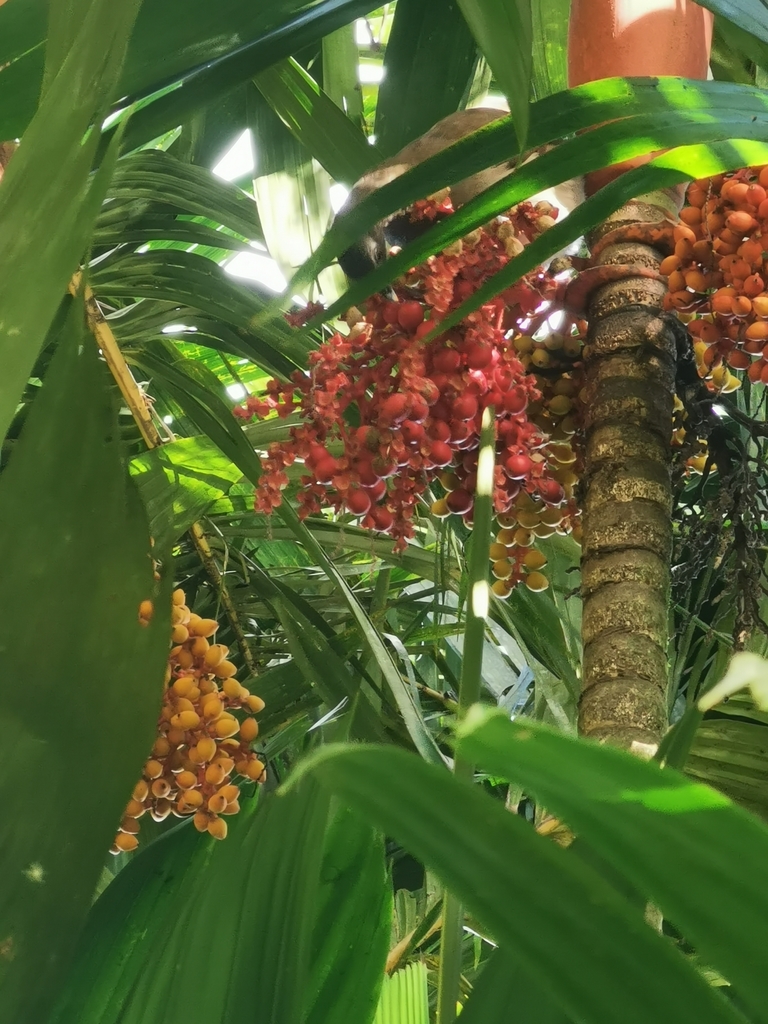
Areca vestiaria
- Origin
- Asia
- Part used
- See detailed notebook
- Tradition
- Traditional ethnobotany
The Areca vestiaria palm, recognizable by its scarlet leaf sheaths, belongs to the same family as the common betel palm (Areca catechu), with which it shares certain traditional uses in the islands of Southeast Asia. In its native range, particularly in Sulawesi (the Celebes), local communities have long paid attention to the fruit of this ornamental yet useful palm. Herbalists' notebooks mention it only sparingly, its documentation remaining limited compared to its more famous cousin.
Traditional uses
Traditional chewing of the seeds
As with Areca catechu, the seeds of Areca vestiaria are said to have been chewed locally, sometimes combined with other substances, for their stimulating effects on digestion and appetite.
Reported mild stimulant use
The oral tradition of certain Indonesian regions speaks of using the seeds as a mild stimulant, promoting alertness and wakefulness, in the manner of the better-known betel nut.
Ceremonial and social use
Like other species of the genus Areca, the fruit has held a place in local social and ceremonial practices, particularly during exchanges or hospitality rites.
Before you use it
Areca seeds contain alkaloids (including arecoline) whose repeated use is associated with risks to dental and general health; caution is called for. As this species is very poorly studied scientifically compared to Areca catechu, no use should be undertaken without the advice of a healthcare professional or qualified botanist. Not recommended for pregnant or breastfeeding women, nor for children, by analogy with the known precautions for related species of the same genus. Do not consume while on medication, as interactions have been reported for arecoline-type alkaloids in related species.
The detailed notebook
- Prepared as a paste or decoction
- Traditional duration of use
- Known contraindications
- Related species and their uses
Where to find it
Partner herbalists — available with the detailed notebook.
Sources
PFAF, Wikipedia