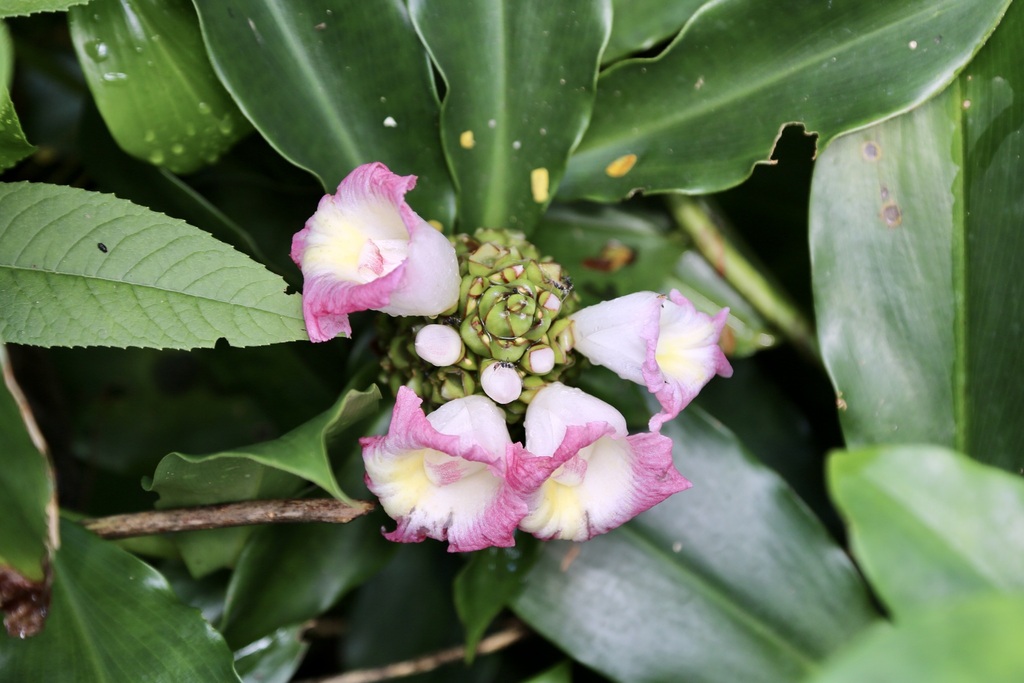
Costus afer
- Origin
- Africa
- Part used
- See detailed notebook
- Tradition
- Traditional ethnobotany
Costus afer, a slender reed of the humid undergrowth of West and Central Africa, has held a discreet but constant place in village pharmacopeias for generations. Its knotty stem and quilted leaves earned this plant the nickname "wild sugar cane" among certain peoples, who chewed its fresh pith. Traditional healers regard it as a plant of general bodily support, particularly during fragile seasons.
Traditional uses
Traditional support during feverish periods
A decoction of the stem or rhizome was traditionally drunk during feverish states and colds, to support the body through these episodes.
Digestive comfort after heavy meals
The chewed or infused stems were reputed to ease bloating and support digestion considered sluggish.
Traditional use around childbirth
In some regions, the rhizome was used by midwives to assist labor during childbirth, a use to be approached with particular caution today.
Traditional care of minor wounds
Juice extracted from the fresh stem was applied locally to superficial wounds or stings, according to reported village uses.
What to know before use
A traditional-use plant still little studied scientifically: caution is advised, particularly over the long term. Not recommended for pregnant women outside of experienced traditional guidance, due to historical uses linked to labor during childbirth. Do not use in young children without the advice of a health professional. Medical advice is recommended before any use, particularly in case of ongoing treatment, due to an undocumented risk of interaction.
The detailed notebook
- Prepared as a paste or decoction
- Traditional duration of use
- Known contraindications
- Related species and their uses
Where to find it
Partner herbalists — available with the detailed notebook.
Sources
PFAF, PubMed