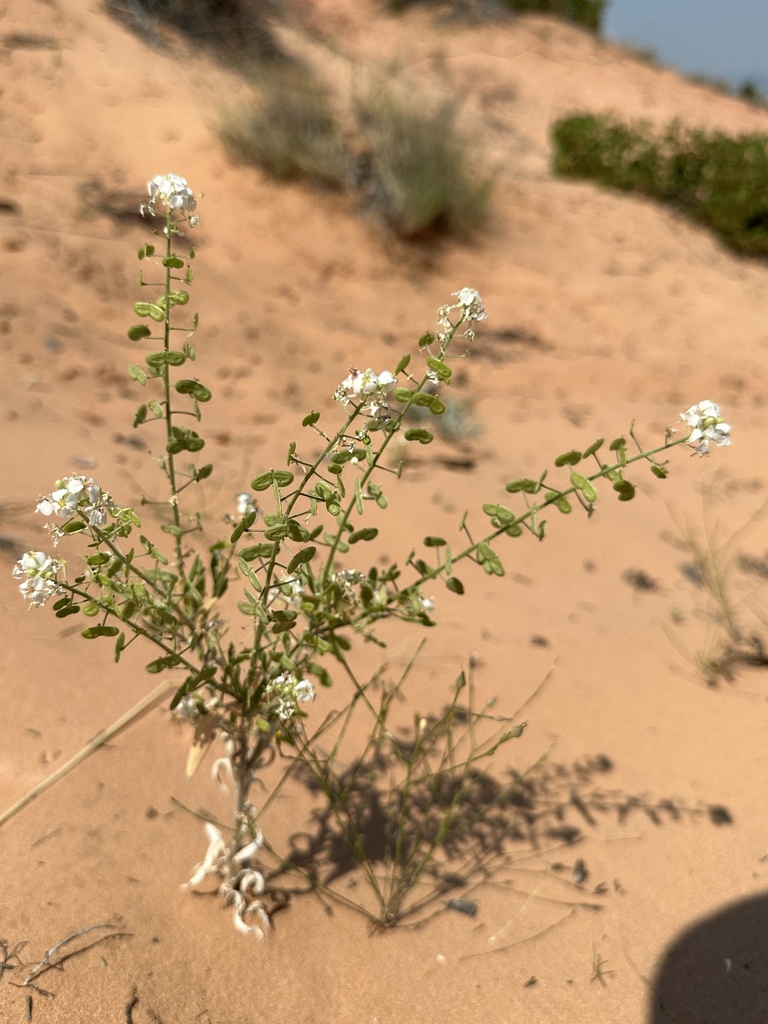
Dimorphocarpa wislizeni
- Origin
- North America
- Part used
- Flowers
- Tradition
- Traditional ethnobotany
A discreet inhabitant of the arid plains of North America, Dimorphocarpa wislizeni, sometimes called "spectacle-pod" by English-speaking botanists, has left only rare traces of use in herbalist memory. The Indigenous peoples of the arid regions of the American Southwest knew it mainly by its flowers, noted here and there in ethnobotanical notebooks without oral tradition ever fixing a precise and consistent use for it.
Traditional uses
A poorly documented plant
Ethnobotanical sources mentioning Dimorphocarpa wislizeni remain rare and fragmentary; no clearly established traditional use can be reported here with certainty.
A regional collector's plant
It appears mainly in the herbaria and floristic inventories of the arid zones of the American Southwest, more as an object of naturalist observation than as a plant of everyday use.
Flowers noted for their appearance
Its flowers, with their distinctive silhouette, may have been picked or observed for their visual interest, without this reflecting any established traditional therapeutic use.
Before you use it
As this plant is very poorly documented in traditional and toxicological terms, any internal or external use should be avoided without the advice of a qualified professional. Do not give to children, pregnant, or breastfeeding women, for lack of sufficient safety data. Without certain botanical identification by an experienced person, refrain from any harvesting or consumption. This does not replace medical advice in case of symptoms or doubt.
The detailed notebook
- Prepared as a paste or decoction
- Traditional duration of use
- Known contraindications
- Related species and their uses
Where to find it
Partner herbalists — available with the detailed notebook.
Sources
PFAF, Wikipedia