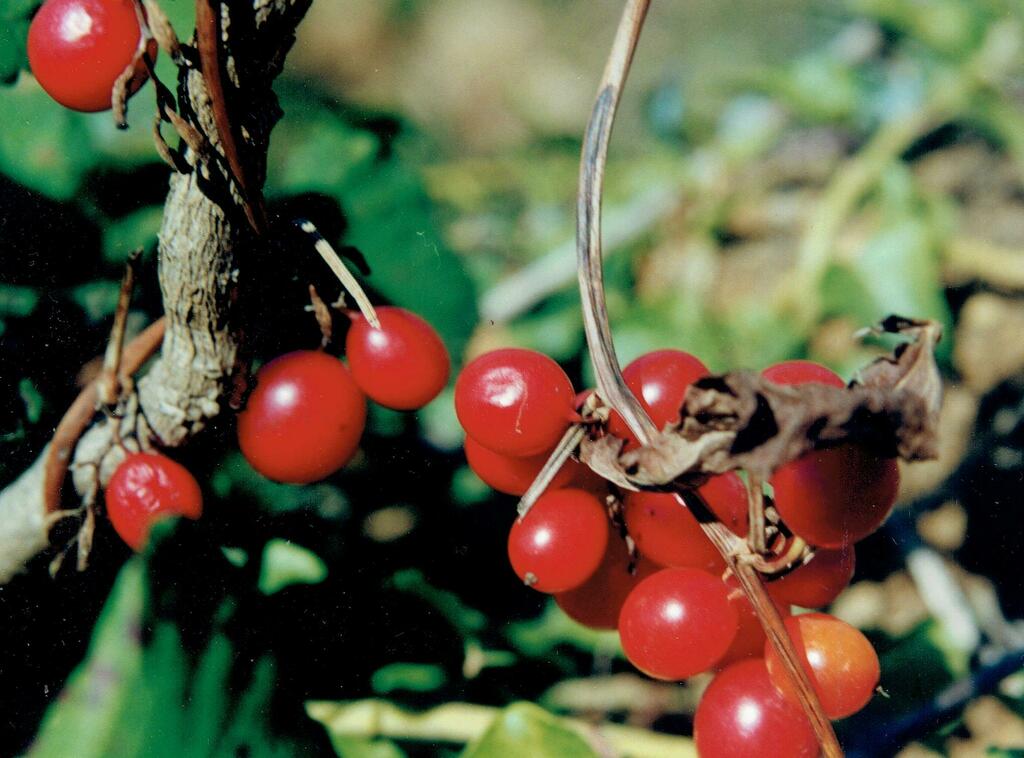
Dioscorea communis
- Origin
- Europe
- Part used
- See detailed notebook
- Tradition
- Traditional ethnobotany
Black bryony, which old-time herbalists sometimes nicknamed the ‘battered women's herb’ or ‘snake's grape,’ has climbed along the hedgerows and woods of Europe for centuries. Its large, rich tuberous rootstock was long reputed in the countryside for specific external uses, passed down with particular caution from generation to generation.
Traditional uses
Application to bruises and contusions
The grated tuber was traditionally applied as a poultice to bruises and hematomas, hence the popular name ‘battered women's herb.’ This external use remains the best documented in European herbal tradition.
Care for local skin conditions
Certain rural traditions used the fresh tuber as a local rub for redness or skin irritation, always as a brief external application.
Rubs for rheumatic pain
The rhizome was sometimes used as an external rub on painful joints, following a folk-medicine logic linked to its known counter-irritant properties.
An old use in folk veterinary medicine
In certain regions, the root was traditionally used for external care of livestock, reflecting an old use passed down largely by word of mouth rather than in writing.
Before you use it
Toxic if taken internally: ingesting the red berries and the tuber can cause severe digestive disturbances and is not recommended for traditional domestic use. External use only, and on healthy, unbroken skin; prolonged contact or use on fragile skin can cause irritation, redness, or even burns. To be avoided during pregnancy or breastfeeding, as well as in children, due to the lack of data and the plant's known toxicity. Any application, even external, should remain brief and be stopped in the event of a skin reaction; the advice of a healthcare professional or qualified herbalist is strongly recommended before any use.
The detailed notebook
- Prepared as a paste or decoction
- Traditional duration of use
- Known contraindications
- Related species and their uses
Where to find it
Partner herbalists — available with the detailed notebook.
Sources
PFAF, Wikipedia