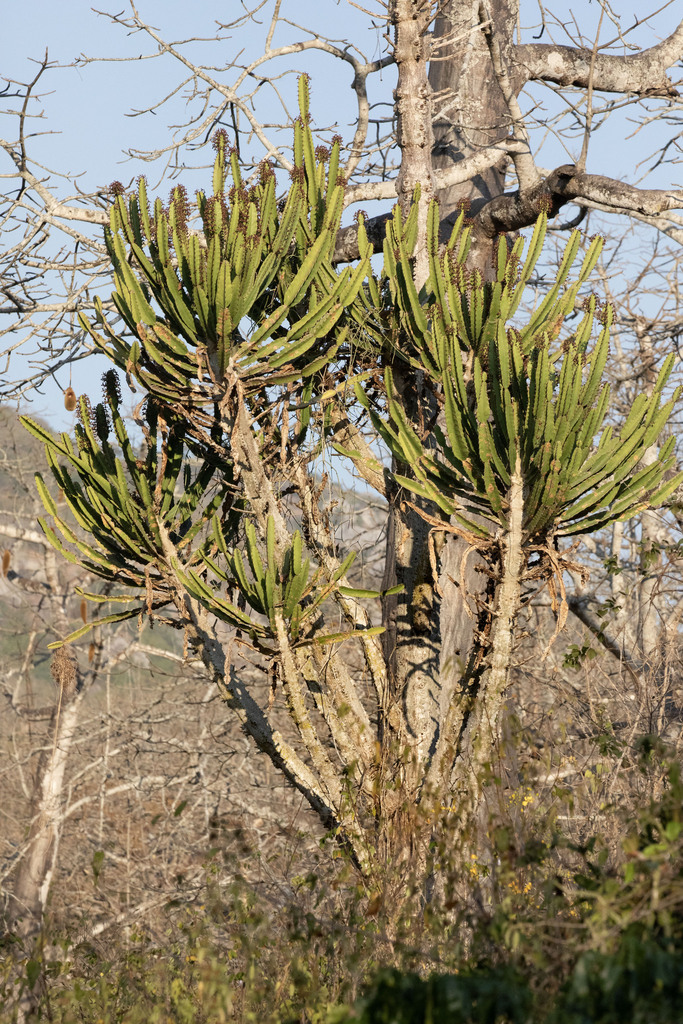
Euphorbia candelabrum
- Origin
- Africa
- Part used
- See detailed notebook
- Tradition
- Traditional ethnobotany
A candelabra silhouette standing in the savannas and rift valleys of East Africa, Euphorbia candelabrum has long marked the landscapes and memories of local communities, more through its imposing presence and feared latex than through everyday domestic use. The elders regarded it more as a plant to be handled with extreme caution than as an everyday remedy.
Traditional uses
Traditional treatment of warts and lesions
The latex, applied with great parsimony and very locally, was traditionally used in certain regions of East Africa in an attempt to remove warts or calluses.
Arrow poison and pastoral use
The highly irritant latex was historically used, diluted or mixed, as a fishing or hunting poison, and sometimes in ritual practices or for protecting herds.
A protective plant barrier
Planted as a dense hedge around dwellings and livestock enclosures, this spurge traditionally served as a deterrent living fence thanks to its caustic latex and thorny branches.
Occasional traditional purgative use
Very small, highly diluted amounts of latex are said to have been used occasionally as a purgative in certain folk traditions, a use now widely discouraged due to its danger.
What to know before use
The white latex is strongly irritating and caustic: it can cause serious skin burns and severe eye damage, including possible temporary or lasting loss of vision if it contacts the eyes. Ingestion, even in small amounts, is potentially toxic and can cause serious digestive problems; it is strongly discouraged without supervision by a qualified professional. To be avoided entirely in pregnant or breastfeeding women, in children, and whenever there is doubt about handling the plant. Cutting, pruning, or any handling of the plant should be done wearing gloves and protective eyewear, imperatively avoiding any contact with the face.
The detailed notebook
- Prepared as a paste or decoction
- Traditional duration of use
- Known contraindications
- Related species and their uses
Where to find it
Partner herbalists — available with the detailed notebook.
Sources
PFAF, Wikipedia