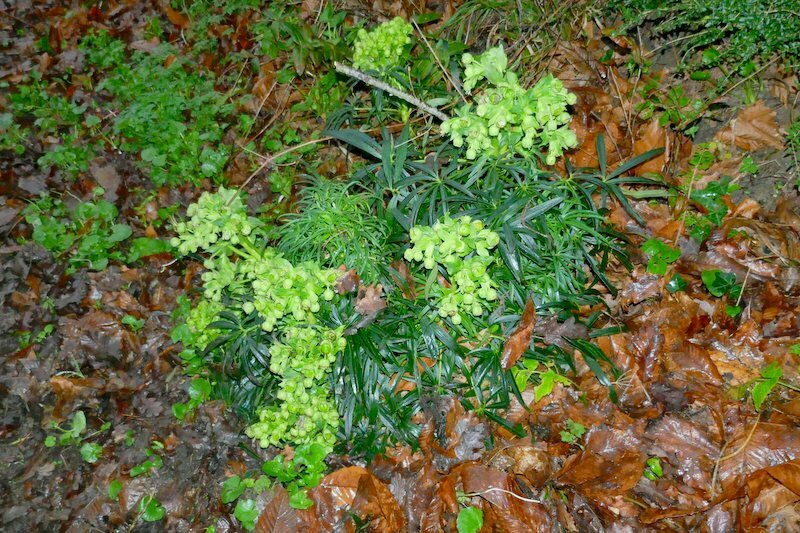
Stinking hellebore
- Origin
- Europe
- Part used
- See detailed notebook
- Tradition
- Traditional ethnobotany
Stinking hellebore, also called "bear's-foot" in the countryside, grows in the shade of Europe's limestone woods and flowers as early as the end of winter. The old herbalists classed it among the "black herbs," powerful plants reserved for very narrow uses and always handled with great caution. Its acrid smell, from which it takes its name, was itself a warning to anyone gathering it of its unusual nature.
Traditional uses
Old traditional purgative
The dried root was once used, in very small amounts, as a powerful purgative in certain European folk pharmacopoeias. This use has now been abandoned because of its toxicity and should never be repeated without strict medical supervision.
Livestock dewormer
In the countryside, a fragment of root was reportedly slipped under an animal's skin or given in a very small dose as a dewormer, a practice now entirely abandoned.
Counter-irritant skin application
The root, ground to a powder, was sometimes applied locally as a diluted poultice for its counter-irritant properties on the skin, following an old folk-medicine logic of "drawing out" an internal ailment.
Traditional treatment for skin parasites
Some herbalist notebooks mention its highly diluted external use against skin parasites in both humans and animals, a historical use that cannot be recommended today without specialist advice.
Before you use it
A toxic to highly toxic plant: all parts, especially the root, contain cardiotonic glycosides and powerful irritant substances. Strictly contraindicated for pregnant or breastfeeding women, as well as children, because of serious health risks. Never take internally without the advice and supervision of a qualified health professional; traditional internal uses have been abandoned today for this reason. Contact with the sap can strongly irritate the skin and mucous membranes; wearing gloves is recommended for any handling.
The detailed notebook
- Prepared as a paste or decoction
- Traditional duration of use
- Known contraindications
- Related species and their uses
Where to find it
Partner herbalists — available with the detailed notebook.
Sources
PFAF