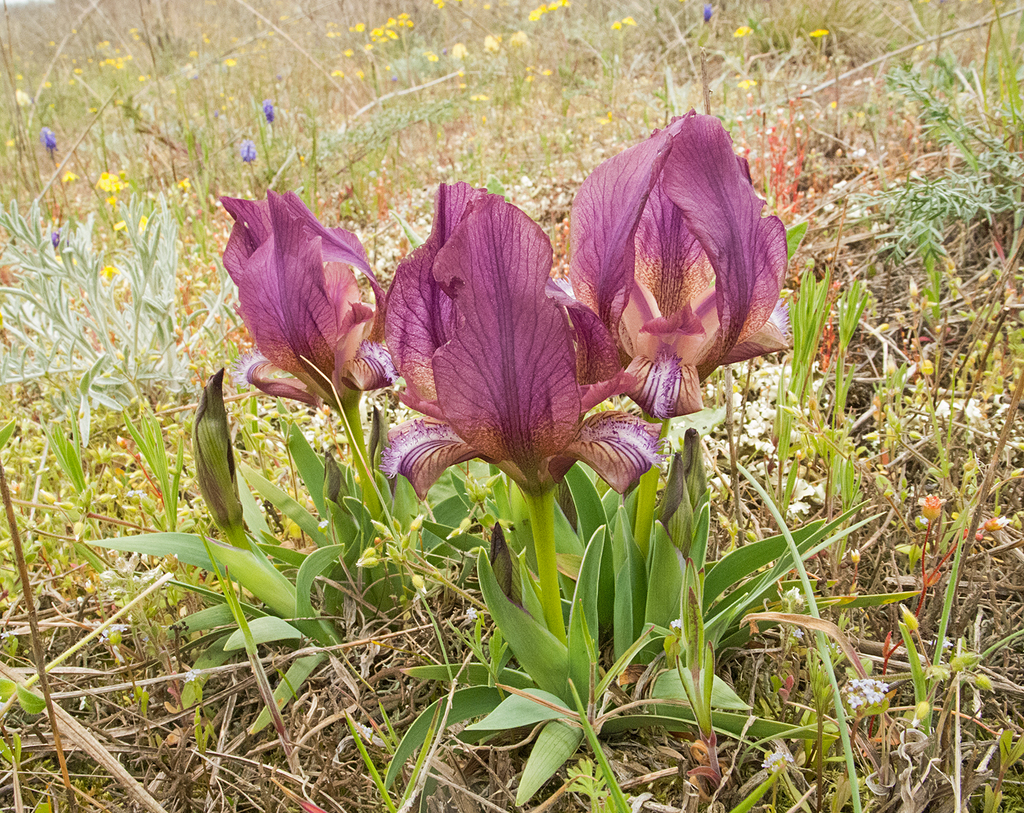
Iris suaveolens
- Origin
- Europe
- Part used
- See detailed notebook
- Tradition
- Traditional ethnobotany
Among the rock gardens and dry lawns of southern Europe, Iris suaveolens raises its mauve, velvet-sheened flowers from spring onward. Less famous than its cousins the Florentine iris or the German iris, it nonetheless shares with them a modest place in the folk uses of the regions where it grows. Mediterranean herbalists of old knew it chiefly by its rhizome, which they treated with the same caution reserved for the iris family.
Traditional uses
Dried rhizome for coughs
The long-dried rhizome was sometimes used in small amounts, in the manner of the Florentine iris, to ease persistent coughs and respiratory catarrh.
External use on irritated skin
As a poultice or a diluted lotion, the prepared rhizome was traditionally used to calm certain minor skin irritations, according to local uses poorly documented in writing.
Fragrant root for linen
Like other fragrant-rooted irises, the dried, powdered rhizome went into sachets to scent and protect linen kept in wardrobes.
Traditional bitter use
In some Mediterranean regions, the rhizome is reported to have been used occasionally, in very small doses, as a digestive bitter, a use that remained marginal and loosely defined.
Before you use it
The fresh rhizome is reputed to irritate the mucous membranes and the digestive tract; only the well-dried and aged rhizome was traditionally used, and in very small amounts. Internal use should be avoided in pregnant or breastfeeding women, as well as young children, in the absence of sufficient safety data. Do not confuse it with other wild iris species, some of which are considered toxic; certain botanical identification is essential before any harvesting. As traditional use of this particular species is poorly documented in the literature, it is recommended to consult a health professional or a qualified herbalist before any prolonged internal or external use.
The detailed notebook
- Prepared as a paste or decoction
- Traditional duration of use
- Known contraindications
- Related species and their uses
Where to find it
Partner herbalists — available with the detailed notebook.
Sources
PFAF