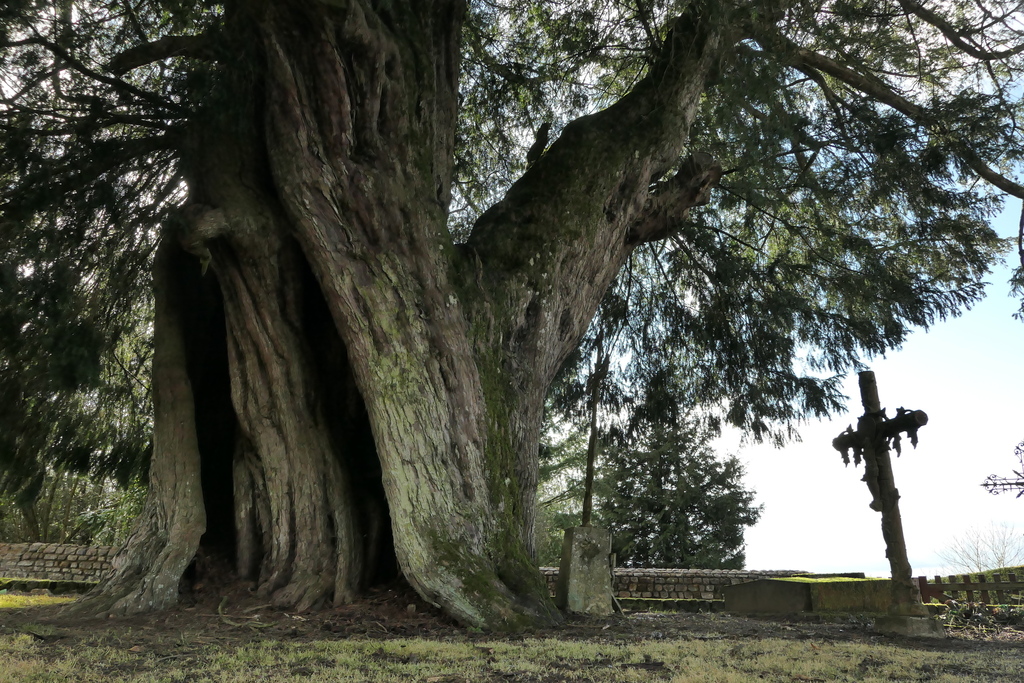
Taxus baccata
- Origin
- Europe
- Part used
- Leaves, Root
- Tradition
- Traditional ethnobotany
Yew, the dark tree of cemeteries and clipped hedges, has been part of European landscapes since antiquity, associated in turn with death and with immortality. The old herbalists kept their distance from it, knowing its reputation as a fearsome poison, while granting it a symbolic place and, more rarely, a few very narrow uses.
Traditional uses
An old dewormer
In some European folk traditions, very weak preparations of yew leaves were used as a dewormer, a use now entirely abandoned because of the plant's toxicity.
A funerary, protective tree
Planted for centuries in cemeteries, yew was regarded as a guardian of resting places and a symbol of passage between life and death in Celtic and Christian belief.
Occasional traditional veterinary use
Some old texts mention a very limited veterinary use of diluted decoctions, a practice now abandoned because of the risk of poisoning, including in animals.
A historical source of studied compounds
The taxanes found in yew have, in modern times, drawn the attention of pharmaceutical research, though this use belongs to medicinal chemistry rather than traditional herbalism.
Before you use it
All parts of yew, except the red flesh of the berry (the aril), are highly toxic and can be fatal, even at low doses. No household use or home preparation is recommended: ingesting the leaves, seeds, or bark can cause severe heart problems, even death. This plant is strictly discouraged around children and animals, as cases of accidental poisoning are well documented. Consulting a health professional or a poison control center is essential in case of ingestion, even minor, of any part of the tree.
The detailed notebook
- Prepared as a paste or decoction
- Traditional duration of use
- Known contraindications
- Related species and their uses
Where to find it
Partner herbalists — available with the detailed notebook.
Sources
PFAF, Wikipedia