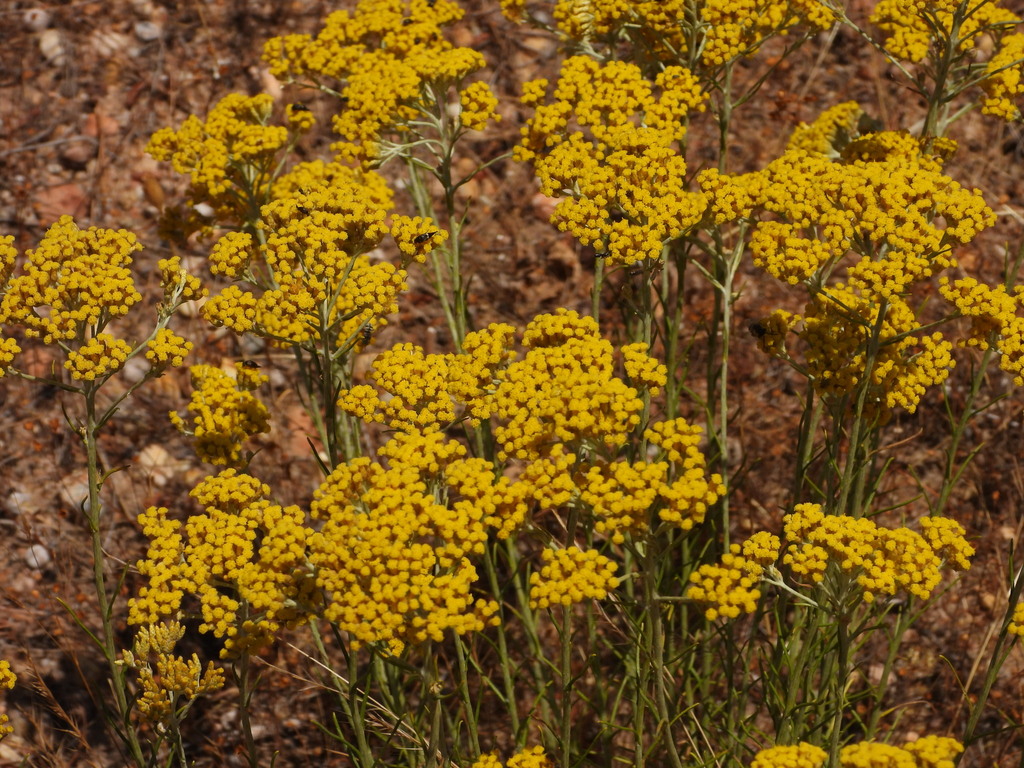
Helichrysum italicum
- Origin
- Europe
- Part used
- See detailed notebook
- Tradition
- Traditional ethnobotany
On the dry, rocky slopes of the Mediterranean basin, Italian everlasting perfumes the air with its warm scent, somewhere between curry and honey. Shepherds and herbalists of southern Europe once nicknamed it "immortelle," because its golden-yellow flowers keep their brightness long after drying. From this reputation as a flower that never fades grew a whole array of traditional uses, passed down from generation to generation.
Traditional uses
Support for the airways
An infusion of the flowering tops was traditionally drunk to accompany colds and soothe coughing, particularly in the countryside of Provence and Corsica.
Care for marked skin
Immortelle essential oil and infused oil are reputed in folk tradition to help calm the skin's appearance after a knock or bruise, and to support the fading of old scars.
Local circulatory comfort
Used externally, immortelle was traditionally applied as a rub or compress to relieve the sensation of heavy legs.
Light digestive support
In the Mediterranean, a mild tea of dried flowers was sometimes taken after meals to help with sluggish digestion.
Before you use it
Italian everlasting essential oil is highly concentrated and should never be applied undiluted to the skin without first mixing it into a vegetable oil. Use is discouraged for pregnant or breastfeeding women, as well as young children, without medical advice. Do not use in case of coagulation disorders or alongside anticoagulant treatments without medical advice, as immortelle is traditionally reputed to thin the blood. If in doubt, or for prolonged use, seek the advice of a pharmacist, doctor, or qualified herbalist.
The detailed notebook
- Prepared as a paste or decoction
- Traditional duration of use
- Known contraindications
- Related species and their uses
Where to find it
Partner herbalists — available with the detailed notebook.
Sources
Wikipedia