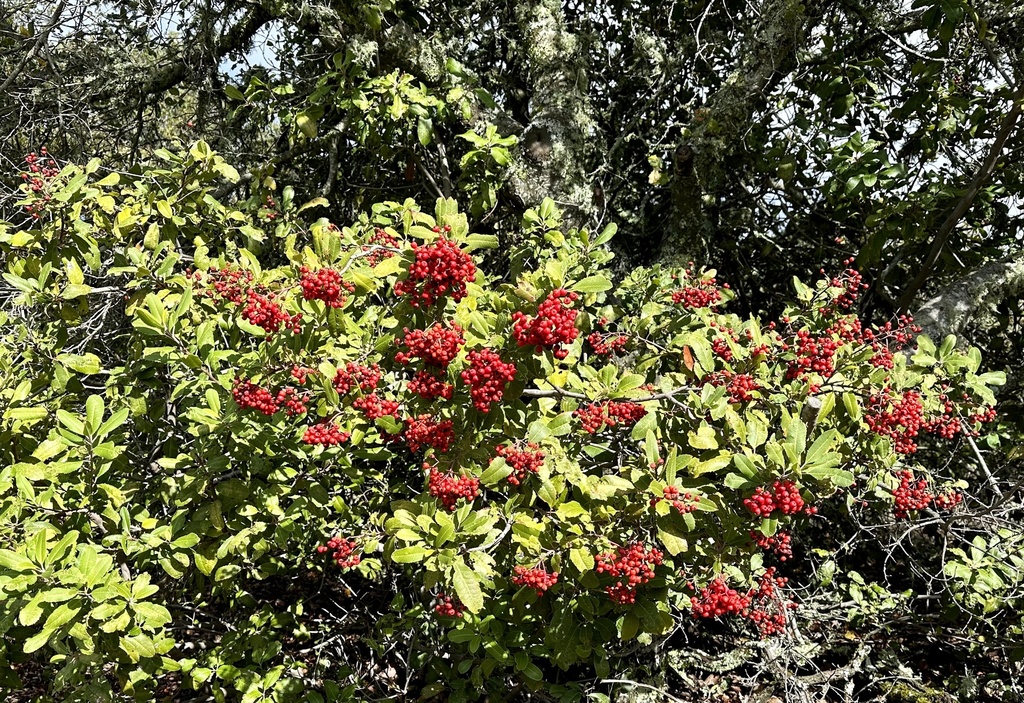
Heteromeles arbutifolia
- Origin
- North America
- Part used
- See detailed notebook
- Tradition
- Traditional ethnobotany
On the coastal hills of California, Heteromeles arbutifolia — also called toyon or "California Christmas berry" — adorns winter with its bright red clusters. The Indigenous peoples of the region, notably the Chumash and the Tongva, had long known its berries and bark, which they prepared carefully before any use, since raw they contain compounds related to hydrocyanic acid.
Traditional uses
Cooked berries as a winter store
The berries, once cooked or thoroughly dried, were traditionally consumed by the Indigenous populations of California as a supplementary food in the cold season.
Bark decoction for stomach ache
The bark was sometimes used as a light decoction in certain local traditions to ease minor digestive trouble.
A soothing external use
A preparation from bark or leaves could be applied as an external wash to the skin, according to local uses that are reported but poorly documented in detail.
Hard wood for small tools
The dense, sturdy wood was traditionally used to make small tools and handles, a secondary but well-attested use among local communities.
Before you use it
Raw berries and certain parts of the plant contain cyanogenic glycosides; they are toxic if consumed without adequate preparation (cooking or prolonged drying). Never consume the leaves or seeds, which concentrate the potentially toxic compounds. Internal use is discouraged without the advice of a professional familiar with this specific plant, as traditional uses are poorly documented in modern literature. Not advised for pregnant or breastfeeding women and young children, as a general precaution.
The detailed notebook
- Prepared as a paste or decoction
- Traditional duration of use
- Known contraindications
- Related species and their uses
Where to find it
Partner herbalists — available with the detailed notebook.
Sources
PFAF